The First Light and the Greater Realm
In the first age, the Creator’s Creation was not born for dust alone.
The ancient writings say that humans were shaped to walk beneath the light of the Greater Realm, a divine plane beyond hunger, envy, war, decay, and death. The mortal world was meant to be a preparation ground, not a prison. It was a field of testing, growth, choice, suffering, mercy, and awakening. If the hearts of men became pure, united, awakened, and free from corruption, humanity would one day ascend together and take its rightful place among the higher realms.
But before Creation was fully awakened, there was already rebellion.
Among the first greater beings was one creature of immense beauty, wisdom, and power. He was made to guard the passage between realms, to guide lesser beings toward the Creator’s light. His task was not to rule men, but to help them rise. He knew the paths between worlds. He understood the laws of spirit, flesh, memory, desire, and judgment. He could see how fragile Creation was, and how easily the heart could be moved by fear or longing.
But pride grew in him.
He desired not to guide creation, but to rule it. He believed that free will was a flaw, purity was weakness, and that mortal hearts could be bent more easily by desire than lifted by truth. To him, Creation was not a future brotherhood of ascended souls, but a harvest waiting to be claimed.
This being became known as The Fallen One.
In the beginning, he could take many forms. He could appear as a king, a beggar, a prophet, a friend, a lover, or a child. He walked among the early kingdoms wearing the face of man, whispering into the hearts of rulers and teaching them how to twist the energies of nature for their own gain. He did not always command evil openly. Often he taught men to call evil wisdom, ambition, survival, justice, or destiny.
But when the greater beings discovered how deeply he had entered the mortal realm, they stripped away part of his power. He could no longer freely become a man. His most dangerous mask was taken from him.
Yet his influence remained.
He hid behind dreams, artifacts, songs, royal bloodlines, cursed relics, false miracles, possessed bodies, and the hunger of ambitious hearts. He became less visible, but more patient. Since he could no longer easily rule Creation by walking openly among them, he learned to make Creation rule itself badly.
The oldest warning of the elves says:
The Fallen One does not need a throne if every king dreams of one.
The First Pure Man and the Birth of Clear Sight
In this chapter
In the earliest days of creation, when men still lived close to the breath of creation, one man was found pure in heart. He was not perfect because he had no struggle; he was pure because he chose truth even when desire, fear, and pride called to him.
The Creator set this man apart, as He had intended from the beginning.
He became known as The First Witness, also called The Savior, the one chosen to help Creation open its eyes. He saw that the world was not only stone, water, flame, blood, and sky. He could hear meaning in the wind. He could sense grief in broken ground. He could look into the face of another person and perceive not only expression, but burden.
Through the First Witness and the One Word, a woman was chosen to begin a new lineage. Her descendants were born with clearer understanding, broader vision, deeper memory, and a greater sensitivity to the hidden forces of the world. Across generations, they slowly became something more than ordinary men.
They became the first Elder-Kin, later called Elves.
The elves remained within the mortal world, less deeply buried in sin than mankind but still susceptible to pride, sorrow, obsession, beauty, and ancient grudges. Their clarity made them wiser, but also more wounded. They remembered too much. They loved too deeply. They could preserve truth for centuries, but they could also preserve bitterness for just as long.
Their sight was clearer. Their lives were longer. Their hearing could sense the song of rivers, stones, forests, stars, and sorrow. They became guardians of memory, but also prisoners of memory.
From this line came the people of Verdanthil, the Elven Enclave, who became keepers of ancient songs, healing arts, moon-silver craft, and the oldest warnings about the Lower Realms.
The One Word and the Elven Responsibility
The elves still teach that the First Witness did not create their greatness. He revealed their responsibility. To see more clearly is not only a gift. It is also a burden, because those who see danger sooner are judged more harshly when they fail to act.
Their responsibility was to spread the One Word through action, not through speech alone. They were not sent merely to teach the peoples of Creation greater skills or place greater powers in their hands. They were meant to help them become good, to live in a way that revealed the path toward ascension.
The elves were not sustained by the perfection of their own nature. They remained close to goodness by keeping their minds and hearts near the Creator and following His Word. That nearness sustained their clear sight and their almost divine command of the forces of physics and nature. It allowed them to exercise extraordinary control without surrendering themselves to the desire for mastery.
Their lineage carried the gift; the One Word gave it direction and sustained their longevity.
The Lost Elves
Some did turn away.
What followed was not a single punishment repeated in every life. Each lost elf suffered a different unraveling.
Some lost their clear sight. Others retained their abilities but found that the forces of nature no longer answered as they expected, and the strain drove them into madness. Some discovered unfamiliar hungers and desires. Others lost their powers altogether. There were those who withdrew into exile, wanting neither speech nor company, unwilling even to look upon the world they had once understood.
Some lost their connection to the source of their long lives and eventually died. Others continued to live through centuries of suffering. A few retained both their powers and a life that seemed without end, even while their hearts remained far from the One Word.
Among the lost, outward strength and inward estrangement could endure together for centuries.
As the ages passed, those who remained lost began to forget their former lives, the meaning of their gifts, and the lineage through which those gifts had come. Some still carried the strength of an ancient elf after even the memory of being Elder-Kin had faded.
Sacredung and the Defense of the Elder-Kin
As the world became a battlefield, the elves could not preserve their people by contemplation alone. Enemies attacked their lands and gathered territories around them. The Elder-Kin answered with their own craftsmanship, strategy, and hunting, learning how to weaken hostile forces before those forces reached their homes.
In those early ages, they kept their greater powers hidden from mankind. Their duty was to guide Creation toward goodness, not to spread magical arts without regard for what those arts might become.
For the training of their own warriors and noble defenders, they built a dungeon through magic. It became known as Sacredung.
Within it were the trials the elves needed to learn battle and survival. The dungeon gave their defenders a place to prepare for the dangers beyond their borders, bringing their knowledge of craft, strategy, and the forces of nature into the training of those who would protect their people.
Sacredung belonged to a people who had been charged to guide the world, but who were increasingly forced to defend themselves from it. That tension would follow Verdanthil through the ages, and would make its later decision to teach a human named Merlin all the more significant.
The Lower Realms and the Corruption of Men
In this chapter
The Lower Realms did not remain silent.
From beneath the world, from cracks in spirit and earth, demons began to whisper. They did not always arrive with horns, fire, and armies. More often they came as desire, pride, greed, lust for power, fear of death, hatred between brothers, hunger for beauty, obsession with wealth, and the dream of eternal rule.
They corrupted Creation through many doors.
Some also entered the world in flesh. They appeared as men, as animals, or as things so horrendous that their very bodies became instruments of fear. The judgment that had stripped the Fallen One of his own freedom to wear mortal form had not made the world safe from the disguises of his legions.
The False Restoration of the Lost Elves
Part of those legions turned its attention toward the elves, especially those who had already become lost.
The demons offered remembrance to beings who no longer knew themselves. They reminded them of their lineage, showed them fragments of what they had been, and taught some to recover powers that estrangement and madness had obscured. But the restoration did not lead them back toward the One Word.
Instead, the demons awakened new desires and strengthened old ones. They stirred lust and longing between elves and humans, and between elves and other creatures, using those desires to draw the lost farther from their former purpose. Some broken elves recovered terrible strength while becoming more deeply captive to the appetites of the world.
They were being rebuilt for the world as corruption had made it: divided, hungry, and prepared for war.
The Corruption of Human Knowledge
Other legions worked directly upon mankind.
They taught early humans forbidden ways to interact with the forces of nature: how to bind flame to metal, how to awaken blood through song, how to use stones to store memories, how to draw power from storms, how to trap spirits in blades, and how to bend beasts through fear. These were not true arts of wisdom, but stolen fragments of creation used without purity.
The danger was not magic itself.
The danger was taking from creation without humility, without sacrifice, without understanding, and without judgment. The demons taught men that power was proof of worth. They taught kings that victory was purity. They taught priests that obedience was holiness. They taught scholars that knowledge had no moral weight.
Later, the great mage Merlin would become the first true mage among humans. He would understand magic not as theft, but as contact with energy, nature, spirit, and the unseen laws of the realms. His own observation would begin that understanding, and the elves would help him deepen it. Merlin learned that true magic was conversation with creation, not domination over it. A river could be asked, but not enslaved. Fire could be guided, but not worshiped. Stone could remember, but should not be forced to lie.
Yet even Merlin’s wisdom would not save him from doubt.
The demons also created and twisted races in the dark: orcs, shadow-born tribes, corrupted beasts, ash-blooded warriors, horned clans, and deep things beneath the earth. Some were bred for war. Some were shaped by curses. Some were once mortal peoples, broken and remade across generations. The Lower Realms did not create life as the Creator did; they mutilated what already existed.
Antordin and the First Draconic Bond
Among the lost elves was one whose name, once restored to him, was Antordin.
The demon Arperis undertook to restore his memories and powers. But immense evil entered the work. As Arperis drew forth what remained of the elf’s ancient strength, the corruption he had introduced accidentally took shape as a possessing spirit.
That spirit seized Antordin. It was not content with the power already returned to him. Driven by the desire for more, it turned the restored elf against the very demon performing the restoration.
Arperis found himself fighting the strength he had helped awaken.
To survive, the demon struck at the root of the possessing spirit, at the place within his own work where that evil presence had formed. At the same time, Antordin and the spirit possessing him struck back.
The two attacks met their purposes together. Arperis was banished into the depths of the Lower Realms, and the possessing spirit was destroyed.
Antordin remained.
His memories had returned. His powers had returned. The evil spirit that had occupied him was gone. Yet he had not returned to the One Word. Freedom from possession had not restored the nearness to the Creator that his people had lost, and Antordin still desired conquest.
Another demon, Trocolnol, sensed the strength emanating from him. Trocolnol inhabited the flesh of a dragon, and from within that great body he approached what appeared to be a man carrying an extraordinary force.
Antordin gave him no time even to meet his eyes.
He had learned how to banish demons. He drove Trocolnol from the dragon’s flesh, leaving the body without the spirit that had occupied it.
Antordin then turned his power upon the emptied vessel. He enchanted the dragon and placed a part of himself within it, giving it a spirit through which it could think, possess a will of its own, and hold devotion to his blood.
The bond ran in both directions: from Antordin to the dragon, and from the dragon to Antordin.
Through that shared spirit, Antordin’s lineage became inseparable from the dragon and its descendants.
Antordin further enchanted the dragon so that it could bear eggs and bring forth offspring. Later, he fell in love with a human woman, and from their union came the descendants who would become known as the Dracons.
The descendants of Antordin and his human love grew alongside the brood of his enchanted dragon, their histories joined by the bond he had made.
Thus the Dracos Houses inherited an elf’s recovered strength and abandoned faith, a dragon freed from a demon, a shared spirit, and a human love.
Those Who Turn Toward the Light
Not all those shaped by the Lower Realms remained slaves to evil.
Some of these races, after long ages of suffering, opened their eyes. They saw that evil was not freedom, but a chain. Portions of these people now live among men, elves, dwarves, and fairies. They still struggle with violence, pride, appetite, and old instincts, but they are proof that even those born in darkness may seek the light.
This truth troubles many kingdoms.
cindrar does not know whether to trust them. Verdanthil remembers too many massacres. Myona`lr respects repentance but distrusts weakness. Elunareth welcomes them in song, then binds them with dangerous fairy oaths. Qamar-in allows them to earn honor through service. Sistolck sells them contracts and calls that mercy.
The question remains unanswered:
Can a creature born from corruption become holy, or can it only become useful?
The answer is taking shape in the lives of those who seek a place among peoples taught to fear them.
Camelot and the War of the First Gate
In this chapter
Before cindrar, before Sistolck, before the desert crowns and the northern fortresses, there was Camelot.
Camelot was not merely a city. It was a high kingdom of the Fairy Realm, a peaceful and beautiful dominion where mortal nobility, fairy grace, and celestial law touched the same ground. It stood near Elunareth, the living heart of the Fairy Realm, where radiant trees, silver towers, and enchanted fields reflected the harmony that mankind was meant to achieve.
Arthur and Merlin Before the Crown
Before Camelot had a throne, Arthur was a simple man struggling to find food and survive. Creatures shaped by demons had destroyed his small village, leaving him to wander through a world where safety rarely lasted.
Merlin had come to know another face of that same world. Near the elven lands, beside beautiful rivers and fields rich with food, he had found a place where he could live in peace. He remained there for a long time, observing nature and learning to recognize relationships between things that others passed without noticing.
Arthur eventually crossed those fields.
Merlin offered him food, and the two began to speak. One knew the world through its beauty and quiet abundance. The other knew it through hunger, violence, and loss. Their friendship began where those two understandings met.
Through Arthur, Merlin came to understand that remaining peaceful was not enough while people beyond his refuge were being destroyed. The beauty he had found could not excuse him from the suffering he had not seen.
Together, they chose to help. They would gather people, teach goodness, organize their defense, and build a kingdom where those who had known only flight could finally remain.
Their plan was simple: find a place that could be defended, then invite people to make a home there.
The Elven Alliance and the Founding of Camelot
Before they began their journey, the elves had already been watching Merlin. They had seen his patience with nature, his passion for understanding, and the peace with which he lived. Now they saw him choose to leave that peace for the sake of others.
The Elder-Kin recognized in that choice the responsibility they themselves had been given: to spread the One Word through action.
They chose to make humanity their ally.
Until then, they had kept their greater arts hidden from mankind. Teaching Merlin was a deliberate act of trust, not a decision to place every secret in every human hand. They helped him gain clearer understanding and greater command of the forces he had long observed. Among the arts they taught him was the ability to travel by teleportation.
Arthur led the effort to reach twenty small villages. With Merlin’s new knowledge, they could move quickly between them, gather those who wished to join, and begin bringing the scattered people together.
They chose a strategically placed site near Elunareth, rich in metals and other materials needed to build a lasting settlement. Merlin used his power to help raise its gates, fortress, and first homes. His work gave the people a beginning that war and poverty might otherwise have denied them.
It was not meant to replace their own labor forever. Within the safety of the new kingdom, they would have to learn to build, provide, and take responsibility for one another. Merlin would help establish their shelter, but the life within it had to become their own work.
Camelot also established a church devoted to the One Creator, so that its people might remain close to the One Word.
Arthur devoted his life to the church and the kingdom. He vowed before the Creator that he would neither marry nor father children, but give his life to spreading the One Word and protecting his people.
Through what the elves had shown him, Merlin understood that the kingdom’s purpose could not end with survival. Its people were meant to grow toward goodness and the greater life for which Creation had been intended.
From those villages and that shared purpose, Camelot grew into the high kingdom remembered by the realms.
In that age, Camelot was ruled by Arthur, a king beloved by many. He was not loved because he never made difficult choices. He was loved because even his hardest choices carried sorrow. Beside him stood Merlin, the first true mage of mankind, who spoke with the energies of nature, stars, rivers, roots, and ancient stones.
Arthur represented noble mankind at its highest. Merlin represented mortal wisdom at its most daring. Elunareth represented the beauty of creation still unbroken. For a brief age, the realms believed that mankind might begin its ascent sooner than expected.
The War of the First Gate
But the Fallen One feared Camelot.
If Camelot endured, mankind might remember its higher purpose too soon. The kingdoms of men might become united not by conquest, but by reverence. So evil forces opened the first great wound between realms. An outer race, brought by demonic influence, tried to enter the earth realm through Camelot’s borders. This became known as The War of the First Gate.
Arthur, Merlin, the fairy courts of Elunareth, the early elves of Verdanthil, and the first noble houses fought together. It was not only a war of armies. It was a war of doors. Gates opened in forests. Mirrors bled black light. Children dreamed in languages no one had taught them. Knights fought enemies who wore the faces of dead friends. Fairy queens sang barriers over rivers while elven archers shot arrows into shadows that had no bodies.
Yet not every attack upon Camelot came through a gate.
The Woman in the Camp
One night between battles, a strange and beautiful woman appeared along Arthur’s path.
She spoke of simple things: the pleasures of living, the beauty around them, and matters that asked nothing of him as a king. Her voice carried a dangerous sweetness, almost like heavenly music. For a brief time, Arthur forgot the battle awaiting him, the people depending upon him, and the purpose to which he had given his life.
The woman was mortal, but the Fallen One had laid an enchantment upon her. Through her presence, he sought to break Arthur’s devotion before the war could be decided by arms.
As they walked, their conversation became poetry. Its words lodged in Arthur’s mind with an ease he did not question. Beneath their beauty was an invitation to abandon any higher purpose and accept the world as it was. The enchantment was meant to carry those verses into Arthur’s ordinary speech, so that the king himself would spread their influence among his soldiers.
During their conversation, they drew close enough for Arthur to feel her breath. Their lips nearly met.
At the end of the walk, the woman asked for refuge among his troops. Arthur agreed and brought her into the camp.
She soon won the soldiers’ affection. She baked for them, sang to them, and showed them a gentleness they had scarcely known since the fighting began. Men who had gone without happiness or tranquility found both in her company. To them, she seemed to have brought a little of the peace they were fighting to preserve.
Then Arthur began to dream.
In his sleep, he heard himself repeating the poetry against his will. Its phrases passed into conversations with his soldiers, and as they listened, their resolve faded. Their willingness to fight weakened alongside their devotion to the One Creator.
Arthur had been given discernment by the Creator. He recognized that something was wrong, and that the disturbance had begun after his meeting with the woman. Yet his feelings for her were unlike anything he had known. He wondered whether he was falling in love, even as the dreams warned him against what her presence might bring.
He turned to prayer.
With his Bible open before him, Arthur asked the Creator for understanding. Why had his heart become so unsettled? What did the dreams mean? Was he meant to remain beside this woman, or was he being drawn away from his vow?
While he prayed, she entered his chamber. At that same moment, a passing wind turned a page of the open book. Arthur noticed, but the woman drew his attention back to their first night together. She asked whether he remembered it, then spoke sweetly of beautiful things she had seen around the camp.
After she left, Arthur returned to the page the wind had opened. The passage he read warned that the enemy could approach in disguise and stand among those who were trusted. He understood it as an answer to his prayer.
But he wanted to examine what he had begun to suspect.
In another conversation, Arthur offered thoughts he believed the woman would welcome. Perhaps they should accept the world as it was. Perhaps life was better spent enjoying what they could feel than pursuing a greater purpose beyond it. He spoke as though he might willingly set aside the work to which he had devoted himself.
The woman agreed, unaware that he was testing her.
Arthur also watched the men around her. He noticed small changes in their manner and resolve. What had seemed only comfort was beginning to draw them away from the purpose that held them together.
He asked her to leave.
She resisted his request, but at last agreed. Arthur sent her away alone into unfamiliar country still made dangerous by the war.
The decision cost him more than he could explain to his soldiers. He was surrendering a companionship he desired and taking from exhausted men the happiness they had found in her presence. They had seen her kindness. They had not shared his dreams or heard the conversations through which his suspicion had grown.
Yet Arthur did not tell them the truth of her departure.
He feared admitting how deeply he had been enchanted. He was ashamed of his private longing and of how close he had come to breaking his vow. He also feared their judgment for sending a woman alone into danger. When he spoke to his men, he told them she had chosen to leave, concealing that he had asked her to go.
It was a lie. His decision to resist the enchantment had not kept shame from drawing him away from the One Word again.
Merlin had witnessed Arthur’s request that the woman leave. He said nothing when he heard the king’s account, but he remembered the difference.
The Death of Sir Garran
Among Arthur’s captains was Sir Garran, a man who had joined him and Merlin when Camelot was still a gathering of villages. He had defended its first roads, shared their leanest meals, and remained their friend after titles began to place distance between them and other men. Whenever he returned from a long patrol, Merlin asked him to stay for supper.
Garran’s son had been taken during an earlier raid. Searchers had brought back tracks, rumors, and the possessions of other captives, but never the boy. Garran continued serving beside Arthur while waiting for news that grew less hopeful with every passing week.
Among the dreams that troubled Arthur after the woman entered the camp, one had shown him Garran kneeling before an enemy emissary.
The emissary promised to return his son. In exchange, Garran would reveal the position of a hidden refuge where Camelot’s wounded and the people rescued from the fighting were being sheltered. The army would have to abandon its defenses to reach them. The enemy would be waiting.
Arthur woke with his friend’s name on his lips.
He did not order Garran’s death or imprisonment. A warning about what a man might choose was not proof that he had chosen it. Arthur asked him privately whether anyone had brought word of his son, and urged him to conceal nothing, however terrible the demand attached to it might be.
Garran said there had been no word.
Arthur kept him close while watching for signs of the danger. He hoped the warning had reached him in time to save his friend as well as the people threatened in the dream.
In one of the battles before the final assault, Garran left his assigned position and climbed toward a ridge overlooking the refuge. Arthur saw him go and followed. When he caught up, Garran was carrying a signal horn beneath his cloak. Enemy troops were already moving through the lower woods, searching for what the ridge would reveal.
Arthur asked why he had left the line.
Garran answered that the enemy had shown him his son alive.
The promise from the dream had been made. Garran had accepted it. A signal from the ridge would give the searching troops the refuge’s position, and he had been told the boy would be released once the bargain was fulfilled.
Arthur ordered him to put down the horn. He promised that the search for his son would continue, but would not promise a rescue he could not guarantee.
“You have promised to keep looking,” Garran said. “They have promised to bring him back.”
Arthur stepped between him and the ridge. He asked him again to surrender. Below them, the wounded could not be moved quickly enough to escape an attack. Garran knew that. He had helped carry some of them there himself.
He drew his sword.
Arthur caught the first blow and tried to force his weapon down. He called Garran by the name he had used before either of them wore a knight’s cloak. For a moment, his friend hesitated.
Then Garran tore free and raised the horn.
Arthur killed him before he could sound it.
The signal never came. The refuge remained concealed, and Camelot’s defenders held their line without knowing how close they had come to losing everyone behind it.
After the fighting, Arthur returned with Garran’s body. He told Merlin everything: the dream, the offer concerning the boy, Garran’s admission, and the surrender he had refused. He did not claim that a dream had given him the right to kill. He had struck when the betrayal became an immediate danger, after failing to turn his friend from it.
Merlin listened beside the body of a man he had expected to welcome home.
He had not witnessed the confrontation. The horn proved little by itself; a captain might carry one for many reasons. Garran’s admission and his attempt to betray the refuge were known to Merlin only through Arthur’s account.
For the time being, he believed him.
Arthur ordered the search for Garran’s son to continue. He would not let the boy’s fate become a punishment for his father’s choice. At the burial, the king helped lower the body and remained after the others had gone.
He had saved the people entrusted to him. He had also killed a man he loved. The lives preserved did not make that loss smaller.
The Demon in the Forest
During the final battle of the War of the First Gate, Arthur became isolated in a stretch of forest. A demon attacked him there, and the king fought until he was close to delivering the killing blow.
Then, to Arthur’s eyes, the creature became the woman he had sent away.
He heard the same almost angelic voice. The poetry returned to him. Exhausted by battle and weakened by his recent distance from the One Word, Arthur believed that the woman herself stood before him. For a moment, he forgot the fight.
He stood still while the demon withdrew.
From far away, Merlin saw only the end of the encounter: Arthur motionless, an enemy escaping, and no pursuit. He had not seen the deception that made the king hesitate.
He remembered Garran.
Arthur had said that their friend could not be spared because other lives were in danger. Now Merlin had watched him let a servant of that same enemy walk away. Without knowing what Arthur had seen, the difference looked unbearable: death for the friend they had loved, and freedom for the creature they had gone to war to resist.
When Merlin later confronted him, Arthur could not remember what had happened. He denied the encounter because it was absent from his recollection. This time, he was not concealing a memory.
Merlin believed he was hearing another lie.
He asked again about Garran. Arthur gave the same account he had given before, but Merlin no longer heard it with the same trust. The earlier lie about the woman’s departure, the death he had not witnessed, and the demon’s escape began to form a single accusation in his mind.
Had Garran truly betrayed them? Had Arthur mistaken another deception for divine warning? Or had he killed their friend for a reason he would never admit?
Arthur had told the truth about Garran. Merlin’s grief and the incomplete scene in the forest made that truth harder for him to believe.
The allies won the war.
The invaders were driven back. Camelot survived.
Merlin’s Pact and the Covenant Blade
But victory did not silence Merlin’s doubt.
He had watched Arthur closely during the war. He had seen the woman’s dismissal concealed, heard Arthur admit to killing their friend, and then watched an enemy escape without pursuit. The king’s denial of that last encounter made him doubt even the explanation he had once accepted for Garran’s death.
Other moments troubled him as well: mercy where he expected judgment, concealed plans, anger, and choices that appeared to endanger the kingdom. Standing beside the king, Merlin believed himself close enough to recognize a failing heart. Instead, he began treating a pattern assembled from partial knowledge as the truth of Arthur’s soul.
The war had been won, but he feared the trials ahead. He sensed a future menace and wanted a weapon powerful enough to protect Arthur and the kingdom. He also wanted certainty about the corruption he suspected in his friend.
Merlin intended to attempt a ritual that would help Arthur return to goodness and the One Word. But the working was dangerous if performed upon a pure soul. Before undertaking it, he believed he had to establish that Arthur was truly corrupted.
So he made a dangerous pact with powers beyond the mortal realm.
He believed himself wise enough to deceive the evil forces with whom he bargained, obtaining a sword that could help restore Arthur without allowing their purposes to defeat his own. He would use the blade to reveal the condition of the king’s spirit before attempting the restoring ritual.
The sword became known as The Covenant Blade.
Its enchantment was holy and terrible. In an impure wielder, it would expose the corruption of the spirit. Once left without a wielder for a single day, it could be taken up again only by someone with a pure heart and a light destiny. Upon that wielder’s death, the souls of his nation would be bound to the mortal world until another truly pure bearer rose to release them.
Merlin gave the blade to Arthur, believing it would either confirm the king’s purity or reveal what his love for his friend, the One Word, and Camelot had failed to see.
But Arthur was pure.
That truth did not make his lie about the woman’s departure honest. Nor did it make his moment of weakness in the forest wise. Yet the king’s failures were not the whole of his heart. He had recognized the danger in a companionship he desired and surrendered it, knowing his soldiers would also lose the comfort it had brought them.
And Garran had truly chosen the bargain Arthur described.
Arthur had not killed him to preserve a secret, silence a rival, or fulfill a dream. He had tried to obtain his surrender, then struck to prevent the signal that would expose the people in the refuge. His sacrifice was the loss of a beloved friend, the burden of having killed him, and the trust he could no longer recover from Merlin merely by telling the truth. Garran’s death was no offering demanded by the Creator.
The demon in the forest had deceived Arthur; he had not knowingly granted an enemy its freedom. Merlin had placed that enchanted hesitation beside Garran’s death and mistaken the contrast for evidence of corruption.
The truth of Arthur’s sacrifice was therefore not that every choice he made had been right. It was that, when his friend’s betrayal forced him to choose, he had protected people who could not protect themselves at a cost he would carry for the rest of his life.
Merlin had mistaken an incomplete understanding of his friend for a judgment upon his soul.
By then, the pact had already placed Camelot in danger. The mage had sought a means to save Arthur, but had accepted terms under which the death of that pure king would bind his entire nation.
The blade had revealed Merlin’s mistake. It had not undone the obligation.
The victory at the First Gate was not Camelot’s last war. In a later, prolonged conflict, Arthur fell.
When he died, the binding terms took hold. The souls of his nation were tethered to the mortal world. Camelot’s people became wandering spirits, caught in the cost of the pact Merlin had accepted.
Their souls now reside in the frozen mountains near Caladorn, Nettleich, and Durenheim, where pale banners move without wind and ghostly knights still guard the passes. They endure as witnesses to a broken judgment, unable to find rest.
They wait for the one who will carry the Covenant Blade again.
To release them, a bearer with a heart as pure as Arthur’s must bring the blade to Nettleich and the truth of Arthur’s sacrifice before the realms. Camelot waits for that vindication.
Camelot is not fully dead.
Elunareth’s Vigil
Camelot is rising again, slowly, through Elunareth’s light and the prayers of those who remember its beauty. The fairy realm holds the waiting spirits close to this side of the veil, sustaining their connection to the kingdom that may yet return.
But Camelot’s return is feared as much as it is desired.
Some noble houses in cindrar claim that freeing Camelot would restore mankind’s true path. Others fear that Arthur’s restored legacy would expose their corruption. Certain fairy courts want Camelot reborn under fairy protection. Some elves argue that Camelot’s fall proves men are too easily broken by judgment and prophecy. The dwarves ask whether any oath that can curse a whole nation should ever have been made.
And deep in Masterotz, the servants of the Lower Realms pray that the Covenant Blade is never found.
Niderul and the Savinighs
Although Camelot’s people became spirits, the kingdom’s influence had already traveled beyond its borders. Tales remained, as did the convictions carried by travelers and outsiders who had lived among its people.
One of those travelers was a merchant named Niderul.
In the days when Camelot still lived, Niderul was trying to help a small cat in distress when he met Merlin. The mage used his power to save the creature, and the merchant watched with bright eyes. What astonished him was not a display before kings or the destruction of an enemy. It was power turned toward a life that might easily have been overlooked.
Niderul asked how he could learn to do such a thing.
Merlin answered:
“This is the universe. This is our walk. These are our feelings. The path is not one thing, but everything.”
At the time, Niderul could not make practical sense of the words.
During his later travels, he bought a scripture containing an enchantment he could read as Aqarin. He did not understand what it meant or how it worked. It was an enchantment of water, through which water could answer the need to be saved.
Then, on one journey, Niderul fell from a waterfall.
As he drowned, his need for rescue became more than a thought. The water responded to his will. In the moment it saved him, he felt himself part of the universe rather than merely a body struggling against it.
He remembered Merlin’s words.
Afterward, Niderul began to explore that understanding through other needs, intentions, and elements. What had once seemed a vague saying became something he could recognize in his own experience. He came to understand the connection Merlin had been speaking of, and then sought the knowledge needed to work with it more deeply.
Through further searching and study, the merchant became a powerful wizard.
Yet when he chose what to do with his strength, he returned to the act that had first moved him. Merlin had saved a small creature. The water had saved Niderul. He decided that his own knowledge should also be used to save.
He founded the Savinighs, an order and council of wizards dedicated to making the world better through the use of their knowledge and power.
Their beginning preserved something of Camelot that its fall could not erase: the example of a mage who had once stopped to help, and of a merchant who had learned that such an act could become the purpose of a life.
The Rise of the Main Kingdom
After the fall of Arthur, the world entered an age of division.
The fairies withdrew into Elunareth. The elves returned to Verdanthil. The dwarves sealed the gates of Myona`lr. Men scattered into hill forts, river villages, coastal ports, and desert tribes. Evil spread through abandoned roads, broken temples, forgotten battlefields, conquered fields, and the empty spaces between broken alliances.
During this chaos, the descendants of Antordin and the human woman he had loved began to rise. They looked like men, but their inheritance was not entirely human. They were long-lived, proud, fierce, and bound to the forces of nature. They called themselves the Dracons. Some called them unwanted. Others called them beasts. Others, in fear or reverence, called them god-proud.
Their greatest families became the Dracos Houses, each noble line bonded to a force of nature and to the ancient flying beasts they rode. They built cities, kept houses, made laws, and crowned kings around that inheritance.
Some houses were tied to storm and sky. Some to flame and ash. Some to stone and root. Some to river mist, sea wind, volcanic heat, or mountain cold. Their riders could cross kingdoms in hours, and their presence alone could scatter raiders, demons, and lesser beasts.
They had once remained isolated, watching the world fall from afar.
But as the Lower Realms spread, they understood that isolation meant death. They expanded, conquered, healed, burned, rebuilt, and unified. Their purpose was to form a central kingdom strong enough to hold the world together.
Their rise was both salvation and conquest.
To villages destroyed by demons, the Dracons were protectors. To petty kings who refused to kneel, they were invaders. To elves, they were dangerous allies. To dwarves, they were arrogant but useful. To fairies, they were fascinating, for they carried wild power but did not always understand the cost of bargains. To the Lower Realms, they were a threat that had to be broken from within.
At their height, the Dracons were ruled by Logmonar, a king of immense will and severe judgment. He believed the world could not survive another Camelot. To him, goodness without strength was only a beautiful corpse. Under his command, the Dracos Houses began watching over the realms from above. Riders searched the world from the skies, crossing mountains, deserts, dead forests, volcanic scars, frozen passes, and seas without names.
Most found only ruins, fleeing cults, or the remains of evil armies that had escaped after Camelot’s fall.
Then, during one of these sky-watches, a lord of one Dracos House saw fire moving beneath the clouds in a land beyond all mapped territory. At first, he believed it to be a burning star fallen to earth.
Then the flame opened its wings.
The rider was Hyperos, a Dracos Rider of great renown, counted among the proudest of the sky-watchers. Hyperos descended to challenge the creature, hoping to wound, bind, or capture it for study. He had fought ash-beasts over Lavgnaron, storm serpents above the eastern sea, and shadow-born horrors near the Wilderness. He believed no winged thing could make him flee.
But the phoenix was far more powerful than the sages had imagined.
Its fire did not merely burn flesh; it burned memory, pride, and courage. Its cry shook the rider’s beast from the sky, and its wings turned the clouds red as blood. Hyperos struck at it with spear, fire, and command, but the phoenix rose through every wound as if pain made it brighter. When its eyes opened fully, Hyperos saw not a beast, but an ancient will filled with ruin, survival, and corrupted rebirth.
The lord fought, but he could not defeat it.
For the first time, one of the proud Dracos fled from battle.
He escaped with his life, but not with victory. The phoenix vanished into the unknown lands and was never seen again.
Hyperos returned to Logmonar wounded and ashamed. Some say half his hair had turned white. Some say the scales along his mount’s neck never grew back. Some say he forgot the names of three of his own brothers because the phoenix had burned pieces of memory from him.
He reported what he had seen: an ancient phoenix, alive beyond the borders of the known world, carrying within itself a flame unlike any other.
Afterward, no army, mage, fairy seer, elven dreamer, or celestial watcher could find it. Some believed it had died and reborn itself elsewhere. Others believed it had crossed into a realm beyond mortal maps. This phoenix had survived the early wars, feeding on ruin and returning from death stronger each time. Some believed it had been touched by the Lower Realms. Others believed it was older than corruption itself, a wild force of creation that evil had tried to claim.
The Dracons gave it many names, but the elves called it the Ashen Phoenix.
The elves regarded the Ashen Phoenix as wild, ruined, and sovereign, older than Draconic law. From a purified remnant of its fire, the allies would seek to raise Lorix, a phoenix of renewal.
Hyperos did not believe the encounter had been chance.
He came before Logmonar with a desperate plan: the phoenix must be found, captured, and joined with the power of other sacred beings to create a source of life strong enough to resist the darkness.
Logmonar did not trust Hyperos’s pride, but he trusted the fear behind it. The Dracons had won too many battles by strength alone, and strength had begun to teach them the wrong lesson. If a fire existed that could survive death, corruption, and forgotten wars, then either the Lower Realms would claim it, or the living world would have to answer it first.
In those days, the Dracons reunited with the elves of Verdanthil and the fairies of Elunareth. Together, they understood that evil had not been destroyed. It had only been driven back. The servants of the Lower Realms had fled beyond known borders, into a nameless and unmapped region where no kingdom held dominion, no road remained safe, and even the old stars seemed uncertain.
The elves warned that corrupted fire could not simply be chained.
The fairies warned that no rebirth comes without exchange.
The Dracons argued that the world had no time for fear.
So the three peoples proposed a desperate ritual. If the world ever fell into darkness again, they would need a living source of light, renewal, and sacred energy. They would combine their own life-force with the forces of nature, then capture the ancient phoenix and sacrifice its corrupted flame to create Lorix, a phoenix of purified fire.
Logmonar bound the effort under the old Sky Law: no single house, crown, or race would own the flame. Dracons would guard its force, elves would guard its memory, fairies would guard its renewal, and mortal witnesses would remember that the covenant existed for the world, not for any throne.
The full hunt failed.
The Ashen Phoenix was never captured.
But where it had struck the earth during its battle with Hyperos, a single ember remained.
It did not cool.
It did not die.
It pulsed like a heart.
The elves called it a wound of fire. The fairies called it a seed of renewal. The Dracons called it the shame of their failed hunt. Hyperos called it proof that his defeat had not been meaningless.
That disagreement was the first crack.
The ember was taken to the center of the continent, not because the place was already holy, but because it stood where many forces met: old rivers, ancient roots, buried stone-lines, crossroads of men, forgotten battlefields, and the broken roads left behind after Camelot’s fall. No single realm owned it. No single race could claim it. That made it dangerous, but also powerful.
There, under guard of Dracos riders, elven singers, fairy oath-weavers, and mortal witnesses, the ritual of Lorix began.
The ritual did not create Lorix in a single moment.
It began as a containment, then became a shrine, then a sanctuary, then a settlement. The ember had to be fed with purified energies over many years. Elves sang memory into it so it would not become mindless flame. Fairies gave it renewal so death would not be its only language. Dracons gave it force, courage, and fire. Nature itself answered through rain, roots, wind, stone, and beasts.
Around the ritual site, wounded lands began to heal. Crops grew where ash had fallen. Springs opened beneath broken roads. Refugees gathered nearby, believing the place protected them.
The first houses built there were not palaces.
They were watch-halls, shrines, healer tents, granaries, and walls of living wood and carved stone. Then came roads. Then came markets. Then came courts. Then came armies.
From this came cindrar, the Capital City.
cindrar was born not merely from an ember, but from the long attempt to turn a failed hunt into a living covenant. It became the seat of the main kingdom, built at the heart of the continent where roads, rivers, forests, and old battle lines met. From cindrar, the central crown sought to rule over the others: not always with wisdom, and not always with mercy, but with the belief that a divided world would be devoured.
Beneath its oldest sanctum was the First Hearth of Lorix, the place where the ember was first purified and where Lorix’s covenant with the world began. The people called cindrar the capital because kings ruled from it. The oldest Dracons called it the Hearth of Lorix. The elves called it the City Built Around a Question. The fairies called it the Place Where Fire Learned to Wait.
For a time, the Dracons succeeded.
They pushed back the darkness from Stoneward, fortified Vigilgate, guarded the northern road through Frostwake, and reopened trade with Keldoria, Dartoman, and later Sistolck. They forced raider clans into treaties, broke demon roads, burned cult shrines, and made lesser kings swear to a central peace.
But their unity did not survive the very power they had gathered.
The old chronicles call the division the Ember Question.
The Hearthwardens believed Lorix should remain hidden, a sacred reserve used only if the world neared collapse. The Crownfire Houses believed he should be revealed and wielded against Masterotz, Eldorath, and Lavgnaron before darkness had time to gather again. The Sky-Claimants argued that only Dracons were strong enough to rule a world defended by Draconic sacrifice. The Penitent Houses answered that mankind had to learn responsibility, or ascension would become impossible no matter how many riders guarded the skies.
Hyperos made the wound personal. He wanted the failed hunt remembered as revelation. Logmonar wanted it remembered as warning. Hyperos’s followers called him the Ember Witness, the rider whose shame had opened the path to renewal. His enemies called him the Rider Who Fled. Logmonar tried to hold the houses together with law, marriages, hostages, oaths, and sky-courts, but every measure made one faction feel protected and another feel betrayed.
Then the Fallen One entered the fractures already waiting in their courts.
Unable to freely take human form as before, he acted through possessed advisors, cursed mirrors, prophetic dreams, enchanted songs, and noble bloodlines. He did not need to invent the Dracons’ pride. He only taught it to speak as duty. Brother turned against brother. Houses accused one another of impurity, cowardice, betrayal, and secret demonic allegiance. Some Dracons claimed the elves had weakened Lorix with sorrow. Some elves claimed the Dracons had stained him with conquest. Some fairy courts quietly profited from both sides by offering binding bargains to desperate heirs.
The civil war began as whispers, then ledgers, then funerals.
Riders vanished during patrols and returned with no memory of the missing hours. Oaths sworn over the First Hearth changed wording when read aloud. A marriage meant to seal two houses ended with every guest hearing the Ashen Phoenix’s cry in the banquet fire. One fire-bound house tried to seize the sealed sanctum beneath cindrar, claiming the covenant had chosen Draconic blood over mortal weakness. A storm-house burned their sky-stables in retaliation. A root-bound house withdrew to Dragonspine Isle. Another made secret contact with Myona`lr for weapons. Exiled riders crossed into the Wilderness and became warlords, carrying fragments of old law like broken crowns.
By the time swords were drawn in cindrar’s upper court, the war had already been lost in the heart.
The Dracons, who had once unified the world, began breaking it. Their beasts grew fewer. Their riders stopped trusting the horns of other houses. cindrar’s people learned to fear wings overhead. Villages that had once prayed for Draconic patrols began hiding their children when shadows passed over the fields.
cindrar survived the civil war, but not unchanged. The old Dracos order collapsed. The houses lost their unquestioned right to rule. Their bloodlines scattered into hidden families, mercenary orders, isolated towers, and exiled sky-clans. Some still serve the crown. Some hate it. Some believe Lorix was mercy. Some believe he was theft. Some still search for the Ashen Phoenix, convinced that the original mystery can only be understood by finding the creature Hyperos failed to capture.
Eventually, another family took the throne of cindrar.
cindrar survived, but the kingdom was never again innocent.
As cindrar became political, divided, and hungry for control, the sacred power that began there withdrew from the capital’s deepest sanctum. The fairies say Lorix was not taken. He answered a deeper call and left the capital with only memory behind.
Beneath cindrar remains the First Hearth: old warmth and ancient memory lingering in the chamber where Lorix’s covenant began. On certain nights it still pulses, warning the worthy and troubling the corrupt.
cindrar remembers Lorix.
And the world may one day need him again.
The Realms in Alignment
In this chapter
The world is divided not only by geography, but by alignment.
Some realms cooperate because they still believe in ascension. Others cooperate only through trade, fear, or survival. Some pretend loyalty while secretly serving the Lower Realms. No alignment is perfectly pure, and no faction is without conflict.
The Greater Alignment includes the Heaven Realm, Elunareth, parts of Verdanthil, Radiant Spire, Zenith Gardens, and the purest orders within cindrar. They believe the world must be healed before humanity can rise. But even among them, there is disagreement. The Heaven Realm values judgment and order. Elunareth values renewal, beauty, and sacred play. Verdanthil values memory and caution. cindrar’s holy orders value action. These values often clash.
The Mortal Concord includes cindrar, Vigilgate, Frostwake, Thornmarch, Willowvale, Keldoria, Dartoman, and some houses of Myona`lr. They are not pure, but they resist the Lower Realms because they know what will happen if the world falls. Their greatest weakness is mistrust. Farmers mistrust nobles. Soldiers mistrust mages. Ports mistrust inland crowns. Dwarves mistrust surface promises. Every alliance must be rebuilt again and again.
The Trade League is centered around Sistolck, Keldoria, Dartoman, Lightharbor, and parts of Qamar-in. They claim neutrality, but gold has a way of listening to demons. Sistolck especially believes every problem can be priced, bought, insured, taxed, or sold. Still, not every merchant is corrupt. Some secretly fund orphanages, pilgrim roads, monster-hunting orders, and redeemed outcast settlements. Others sell holy relics to cults and call it business.
The Self-Sustained Realms include Verdanthil, Elunareth, Myona`lr, Qamar-in, and the desert settlements around Brimstead. These places rely less on global trade and more on their own traditions, resources, and ancient laws. They are harder to corrupt through luxury, but easier to corrupt through pride, isolation, and old hatred. Their conflict is simple: they survive because they keep themselves apart, but the age of ascension may require them to open their gates.
The Broken Alignment includes Masterotz, Eldorath, Lavgnaron, parts of the Wilderness, and the hidden cults beneath many cities. These places are openly or secretly tied to the Lower Realms. But even here, nothing is simple. Not everyone born in Masterotz is willing to serve madness. Not every witch in Eldorath worships demons. Not every warrior in Lavgnaron loves infernal power. Some of the most desperate hopes in the world burn inside lands everyone else has already condemned.
The Draconic Remnants are not a formal alignment, but they matter. Scattered Dracos bloodlines, old rider families, sky-clans, and beast-keepers still exist across Dragonspine Isle, cindrar, Stoneward, Lavgnaron’s edges, and the Wilderness. Some want restoration. Some want revenge. Some want the truth about Antordin’s first bond, Hyperos, Logmonar, the Ashen Phoenix, the First Hearth, and Lorix. Their civil war never fully ended. It only became quieter.
The Savinighs are a wizardly order rather than a realm. Founded by Niderul, their council carries forward the purpose he found in Merlin’s example: to use knowledge and power to save and to make the world better. Their origin belongs to Camelot’s legacy, but their founding purpose concerns the world beyond a single kingdom.
Melanore’s Order is a small witch order of women founded in Eldorath by Melanore, the former queen of Dartoman. Its members share shelter and the study of witchcraft, but disagree over how far loyalty to their founder should carry them into her vengeance. The order does not represent every witch or marsh-keeper in Eldorath, and it owes no allegiance to Mad'n ras.
The chief organized cult of evil wizards in the present age is Mad'n ras. Its schools and hidden circles belong to the Broken Alignment, though many operate inside cities that oppose the Lower Realms. The Doctrine of the Certain Night promises a place in darkness’s dominion to those who help it rise. While the Veiled Hunt targets lives capable of awakening others and the Hollow Root attacks Stoneward’s alliance with Elunareth, Mad'n ras trains the wizards and builds the institutions of a coming occupation.
The world is not divided between good kingdoms and evil kingdoms.
It is divided between places still willing to repent and places that have forgotten how.
The Crowns of the Present Concord
cindrar’s claim to central leadership does not mean every allied city has the same form of government. Stoneward’s local crown and Dartoman’s Tide-Crown operate under different charters acknowledging obligations to the central kingdom. Their rulers can govern locally while disputing taxes, military demands, or the interpretation of those obligations. Sistolck’s recently established commercial kingship rests on its own guild settlement; Vaenor does not become ruler of the whole Trade League merely by wearing its wealthiest city’s crown.
These arrangements have survived because no ruler can easily dispense with the others. Rosvald’s government needs food and ships. Odran needs dependable roads and outside assistance. Halveth needs authority which his own harbor will recognize. Vaenor needs customers prosperous enough to repay him. Their present disputes concern actual people, unfinished obligations, and resources already promised more than once.
Ilyra Fen and the Work of the Savinighs
The current First Convenor of the Savinighs is Ilyra Fen, a former field healer who still carries a patched treatment bag to council meetings. She coordinates the order’s work and believes Niderul’s example is most easily betrayed when saving lives becomes an excuse to govern the people being saved.
Ilyra knows how to organize an evacuation and how to tell a commander that a ward will not hold. She is less skilled at leaving a problem unfinished. Her tendency to take responsibility for every patient can make her promise more than her order can deliver. Members of her council disagree over how many rescuers she should risk in cities whose rulers obstruct their work.
Elian has approached the Savinighs about the changes in Rosvald. A separate message asks Ilyra to help a child preserve the memory of a forbidden working. She has not yet personally examined either the king or Tavin. Access, trust, and the survival of witnesses are obstacles before magical knowledge can be useful.
Ilyra wants to help Tavin understand and safely share the Last Severance so that trained adults can carry its burden. Some colleagues want to destroy the knowledge once Vharok is defeated. Others see an opportunity to recover methods long forbidden. The disagreement has reached a council founded to save.
Mad'n ras has begun addressing the Savinighs directly. Its lecturer Mereth Ansel, once a healer who worked beside Ilyra during a flood evacuation, sends invitations promising protected hospitals under the coming rule of the Lower Realms. Her letters name patients Ilyra could not reach. They do not name the people who survived because she went elsewhere.
Ilyra has kept the letters. She wants her council to understand the offer being made to its exhausted members, rather than pretend only fools could listen. She also insists that providing a route out of Mad'n ras must involve more than demanding a declaration of repentance. A departing apprentice may need shelter; a departing master may need to surrender prisoners, records, and the means by which others remain bound.
Work Beyond the Crowns
The failures of royal coordination have opened work that no single office can manage. Caravans hire escorts who do not share their employers’ nationality. The Savinighs seek guides and field assistants as well as wizards. The Poor Lantern Brotherhood needs people who can carry testimony beyond a landlord’s reach. Harbor rescuers recruit boat crews before asking which banner they honor.
They travel alone or in companies, guilds, households, and temporary partnerships. Some accept payment; others act from faith, obligation, curiosity, friendship, or a wish to make amends. Their employers call them adventurers, outsiders, auxiliaries, or troublemakers according to what happened at their last meeting.
Trust is particular. A person who has kept a convoy safe may be welcomed by its drivers and still refused access to Elunareth’s inner courts. An excellent translator may need an escort through a pass where a practiced soldier requires help reading the stones. A company honored in one city can be distrusted in another because its patron profits from the other city’s hardship.
Their work has already begun to cross jurisdictions. The same shipment may carry medicine for a public infirmary, stone samples for dwarven inspection, and a sealed letter whose author cannot safely use the Road Office. Those journeys let people build relationships outside the arrangements their rulers have failed to maintain.
Their influence grows through the promises they keep and the people willing to trust them with another journey.
The Main Continent
In this chapter
- Elunareth — Fairy Realm
- The Accord Under Strain
- Camelot — Fairy Realm
- The Search Before the Bearer
- Verdanthil — Elven Enclave
- Keldoria — Harbor Town
- Thornmarch
- Myona`lr — Dwarven Stronghold
- The Stoneward Commissions
- cindrar — Capital City
- King Rosvald and the Borrowed Crown
- The Assistant Who Arranges the Truth
- Elian’s Refusal
- The Lectures After Curfew
- Stoneward
- King Odran and the Stone-and-Bloom Accord
- The Cult Beneath the Supply Road
- Hakolen and the Last Valdren
- The Child and the Forbidden Scroll
- The Fight at the Bindery
- Four Years in Hiding
- The Beast That Has Not Yet Come
- The Price of the Replacement Stones
- Vigilgate — Military Village
- Moonlake
- Willowvale
- Frostwake
- Caladorn — Caladorn Pass
- Nettleich
- Those Who Approach Without the Blade
- Durenheim
- Wilderness — Lawless Frontier
- Sistolck — Trade Metropolis
- King Vaenor and the City His Family Built
- The Scholarships of the Certain Night
- Eldorath — Cursed Swamp
- The Queen’s Former Teachers
- The Road to the Unlit College
- Masterotz — Forsaken Keep
- The Unlit College
- Lavgnaron — Volcanic Wastes
- Commissions for the Rising Below
- Qamar-in — Desert City
- Duel Arena
- Zardamank Ruins
- Brimstead
Elunareth — Fairy Realm
Elunareth is a radiant fairy realm of living trees, crystal towers, glowing flowers, ancient spirits, and fields that seem to breathe beneath starlight. It is one of the few places where the mortal world still remembers the Greater Realm. Fairies here are joyful, dangerous, wise, childish, merciful, and terrifying all at once.
Elunareth protects the remaining path to Camelot and guards old memories of Arthur, Merlin, and the Covenant Blade. Its prayers sustain the vigil of Camelot’s waiting spirits.
But Elunareth is not harmless.
Its beauty makes mortals forget the weight of time. A traveler may dance for one night beneath its luminous trees and return to find a year has passed. Fairy hospitality is real, but so are fairy bargains. A promise spoken under Elunareth’s silver branches may bind a bloodline for generations.
Beneath Elunareth lives Lorix, awake, whole, and sheltered by choice and covenant. The Court Beneath the Roots guards his refuge while kingdoms beyond the forest continue to argue over the power they believe cindrar still holds.
This is why Elunareth never fully fades, even when evil rises elsewhere. Its flowers glow in seasons when they should die. Its rivers heal wounds that medicine cannot touch. Its trees sometimes bloom after battles fought far away. The fairies say this is not magic alone. It is the breath of the hidden source beneath the realm.
The great rumor of Elunareth is that one fairy queen knows the exact place where Merlin hid his final confession after Arthur’s fall. She has never denied it. She only asks why mortals believe they deserve the truth before they are ready to forgive it.
Elunareth’s internal conflict lies between the Court of Returning Light, which wants Camelot restored, and the Court of Thorned Mercy, which believes Camelot’s curse protects the world from repeating Arthur’s tragedy too soon.
A third, quieter court is sometimes whispered of: the Court Beneath the Roots. Its members do not govern the surface realm. They keep silence near the deep places where Lorix rests. They believe the greatest danger to Lorix is not Masterotz, but any kingdom that calls its greed protection.
The Accord Under Strain
The threatened mineral alliance with Stoneward has given Elunareth’s courts a present dispute that cannot be settled by remembering Camelot. Lethiel, envoy of the Court of Returning Light, wants the fairy realm to honor its promises even while human officials obstruct investigations. Representatives of the Court of Thorned Mercy argue that each new escort and healing mission draws their people farther into a conflict sustained by mortal secrecy.
Lethiel now keeps a room beside Stoneward’s public infirmary and travels between the two realms to argue her case. She carries names and injury records alongside diplomatic letters. Some miners trust her more than their own paymasters; others resent being discussed as a reason for another dangerous convoy.
The mineral accord strengthens Elunareth’s outer wards and shared roads. Its public negotiations occupy Lethiel while the Court Beneath the Roots maintains its silent vigil in the deep places.
Camelot — Fairy Realm
Camelot is both a fallen kingdom and a returning one. Its physical halls are hidden, broken, or shifted between realms, while its cursed people haunt the cold mountains. Some say Camelot will fully return only when Arthur’s nation is released from the ghost curse.
Camelot grew from twenty villages into a kingdom almost worthy of ascension. Its songs still remember the refuge Arthur and Merlin built; its ghosts endure the pact that followed their victory.
No map shows Camelot correctly. In Elunareth it appears as a distant golden city beyond mist. In Caladorn it appears as ruined towers reflected in ice. In dreams it appears whole, filled with feasting halls, banners, and knights who do not know they are dead.
The mystery of Camelot is that some children in Willowvale and cindrar are born remembering songs no living bard taught them. The elves believe these children carry echoes of Camelot’s suspended souls. The holy orders believe they may be signs of the coming blade-bearer. The Veiled Hunt has begun searching for them.
Camelot’s contradiction is painful: it was purer than any kingdom after it, yet its legacy now haunts the world like a warning.
The Search Before the Bearer
Elunareth’s vigil, Verdanthil’s withheld memories, the songs remembered by children, and the records scattered through mortal libraries have drawn different searchers toward the same lost kingdom. They do not all seek a sword. Some seek an ancestor, an explanation for a dream, or an account their own rulers would prefer destroyed.
The searchers disagree over how the fragments fit together. A childhood song, a burial record, or a dream may open a new path into Camelot’s history. Each has drawn claimants, skeptics, and frightened families into the search.
The living preserve threatened evidence, distinguish witnesses from echoes, and seek safe approaches to Nettleich. Some try to prevent Camelot’s name from becoming a justification for another war. Their findings pass between expeditions, keeping the search alive when a journey fails.
Verdanthil — Elven Enclave
Verdanthil is the home of the Elder-Kin, whose lineage began through the woman chosen by the First Witness and the One Word. Their clear sight endures beside pride, sorrow, beauty, nostalgia, and a long habit of waiting until action is almost too late.
Verdanthil is self-sustained and deeply spiritual. Its people trade rarely, but when they do, their medicines, bows, songs, and moon-silver are priceless. Its trees are said to remember every footstep taken beneath them. Its rivers carry fragments of prophecy. Its towers are grown as much as built.
Its martial tradition includes Sacredung, the magically constructed dungeon where elven warriors and noble defenders train for battle and survival. The same people who once concealed their powers from mankind chose to teach Merlin when they recognized his willingness to use knowledge in service of others. That alliance remains part of Verdanthil’s history alongside its long habit of withdrawal.
The hook of Verdanthil is the Silent Grove, a place where no song can be sung. The elves claim it fell silent after Merlin’s pact, because the forest refused to bless a judgment made against a pure king. Some younger elves want to break the silence and reveal what the grove remembers. The elder councils forbid it, fearing that the truth may condemn not only Merlin, but Verdanthil’s own role in failing Arthur.
Verdanthil’s internal conflict is between the Memory-Keepers, who believe the past must be preserved at any cost, and the Dawnwardens, who believe memory becomes sin when it prevents action.
Keldoria — Harbor Town
Keldoria is the western gate of the continent. It connects cindrar, Thornmarch, Dartoman, Sunmist Isle, and distant islands. Sailors here carry rumors faster than ravens, and demons often hide in cargo, songs, coins, and foreign relics.
Keldoria is loyal to cindrar in public, but its merchants often serve whoever pays.
Its great contradiction is that the city’s chapel bells ring every dawn to bless departing ships, while its black-market docks open every midnight beneath the same holy district. A relic may arrive in the morning under royal seal and leave by night wrapped in fishcloth and false ledgers.
The central rumor of Keldoria is that one ship returns every seven years with no crew, no cargo, and wet ash in its hold. The harbor masters deny this, but old sailors call it the Phoenix Tide, believing it somehow connects to the unknown lands where Hyperos saw the Ashen Phoenix.
Keldoria’s internal conflict is between the Tide Oath Captains, who still serve cindrar honestly, and the Free Ledger Consortium, which believes loyalty is just another negotiable price.
Thornmarch
Thornmarch is a rough borderland of farmers, old knights, broken towers, and forgotten claims. It has produced many loyal soldiers and many bitter rebels. Because it sits between Verdanthil, Keldoria, and Lavgnaron, it is constantly pulled between trade, war, and survival.
The people of Thornmarch are famous for endurance. They repair walls faster than kings send aid. They bury their dead with tools as often as weapons, believing every soul should enter judgment as a worker, not merely as a victim.
The hook of Thornmarch is the Bannerless Tower, an old fortress where no lord’s flag will remain raised. Every banner placed there is found torn by morning, though no guard ever sees who does it. Some say the tower rejects false claims. Others believe the ghost of a Camelot knight guards the land against unworthy rulers.
Thornmarch’s internal conflict is between loyalist families who still honor cindrar’s crown and freeholders who believe the capital remembers Thornmarch only when soldiers or taxes are needed.
Myona`lr — Dwarven Stronghold
Myona`lr is the mountain kingdom of the dwarves. They are masters of stone, metal, memory, and oathcraft. They understand the bones of the world better than any race of men.
But Myona`lr has a dangerous history. Dwarves know how to bind energy into weapons, armor, gates, and engines. Some of their oldest crafts came from knowledge that may have been touched by the Lower Realms. They are not evil, but they are tempted by mastery.
Myona`lr’s deepest halls are arranged like a memory palace. Every gate records the oath spoken when it was carved. Every royal tomb contains not only a body, but a ledger of promises kept and broken. To lie under Myona`lr stone is considered dangerous, because the mountain remembers.
The mystery of Myona`lr is the Unopened Forge, a sealed chamber older than the current dwarven dynasties. Its door bears no lock, only a warning: What can be made here can also unmake its maker. Some believe it contains the method by which Lavgnaron ore can be purified. Others believe it contains the first weapon ever made with demonic instruction.
Myona`lr’s internal conflict is between the Deep Oath Clans, who want the old forbidden crafts buried forever, and the Bright Anvil Reformers, who believe the coming war requires every tool, even dangerous ones.
The Stoneward Commissions
Stoneward’s vesperite trade has brought the dispute between restraint and mastery into Myona`lr’s active workshops. Dwarven refiners are being asked to distinguish ordinary wear in convoy ward-stones from deliberate changes introduced by the Hollow Root. Some altered pieces passed inspection under reputable household seals. The mountain’s memory cannot excuse a craftsperson from examining the object actually placed before them.
The Deep Oath Clans want suspect commissions suspended until their purpose is understood. Bright Anvil Reformers argue that stopping all work will leave the convoys undefended. At the active forges, smiths weigh those arguments against the names on their next commissions.
cindrar — Capital City
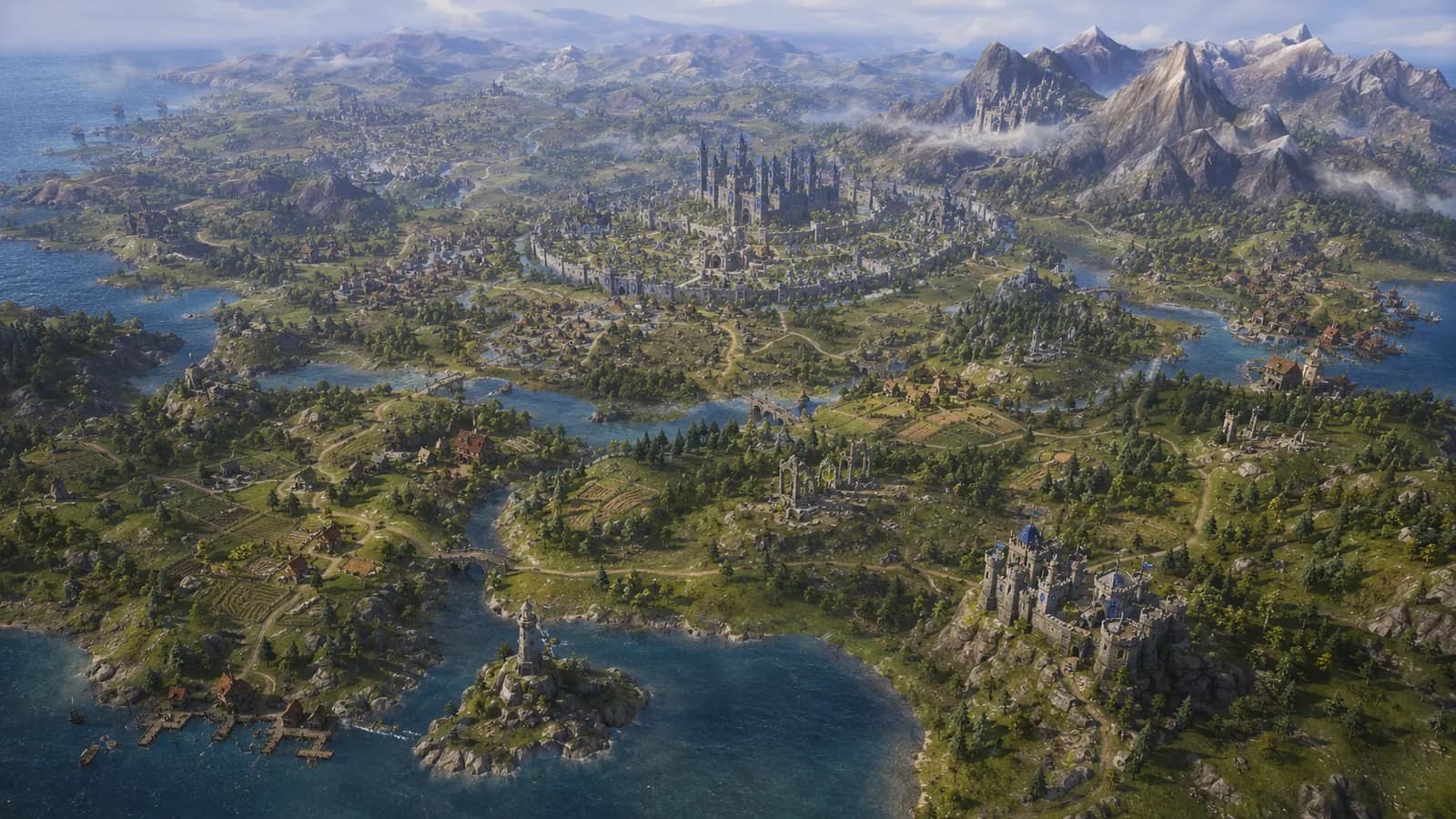
cindrar is the capital of the main kingdom and the political heart of the continent. It is a city of courts, temples, armies, scholars, nobles, spies, and holy orders. It claims to protect mankind’s path to ascension, but many within its walls seek only power.
cindrar draws people into the difference between serving a crown and protecting the people beneath it. A disputed order, a closed archive, or a prisoner’s petition can begin an involvement that no royal summons anticipated.
Beneath cindrar’s oldest sanctum lies the First Hearth, enclosed by elven song-seals, fairy oaths, Draconic flame-runes, dwarven stone locks, and mortal prayers. Above it stand the palaces and councils; around them, homes, markets, barracks, gardens, archives, and temples.
Most citizens know cindrar as a city of law and believe its holiness comes from the power buried beneath it. The oldest families know that Lorix departed. What remains in the chamber is warmth without flame, memory without body.
That knowledge frightens them. The capital had not been rejected by an enemy. It had been judged by the very light it tried to claim.
The great contradiction of cindrar is that it preaches unity while being divided into factions: crown loyalists, reformist priests, old Draconic bloodlines, merchant houses, military commanders, holy orders, secret cults, and scholars who suspect the official history is incomplete.
The rumor whispered in cindrar’s lower districts is that the capital does not choose its kings. The First Hearth beneath it does. Whenever a ruler becomes too corrupt, strange fires appear in the old tunnels.
Some nights, pale gold flames rise along the sealed doors beneath the oldest temple. Priests call them warnings. Draconic descendants call them grief. The fairies say they are merely the First Hearth remembering the one who began there.
cindrar’s internal conflict is the heart of the present age. It must unite mankind, but it does not yet know whether it deserves to lead mankind.
King Rosvald and the Borrowed Crown
The family that eventually succeeded the Draconic rulers of cindrar is House Ardel. Its present ruler is King-Regent Rosvald Ardel, younger brother of the late King Maeron. Eight years before the opening of the game, Maeron died and left a nine-year-old daughter, Princess Elian. Rosvald accepted the regency until she reached eighteen.
The ceremonial title permits the court to call him king, but the inheritance remains Elian’s. Her eighteenth birthday falls in the coming winter. The question of whether Rosvald will surrender the crown is no longer a matter confined to the royal household.
Before his affliction, Rosvald was known for patiently hearing disputes that grander rulers would have passed to a clerk. He had spent years supervising roads and supply stores rather than seeking a throne. He disliked pageants, mended his own riding gloves, and could recognize the voices of several petitioners who appeared at his court every year. He could also be stubborn, slow to dismiss an old servant, and too ready to believe that a compromise remained possible because he needed it to be.
Now he sometimes orders a gate opened and then demands the arrest of the officer who opens it. He hears accusations in innocent conversations. He searches rooms for people who have been dead for years. On clearer mornings, he remembers enough to be frightened by what bears his signature.
The city calls its king mad. The cause concealed inside the palace is deliberate sorcery.
The Assistant Who Arranges the Truth
Selvar Drenn, Rosvald’s confidential assistant, appears to be the least remarkable man in the royal chambers. He carries appointment books, corrects dates, and remembers which visitors the king has agreed to receive. A willing human sorcerer of the Soft Masks, he has made himself indispensable by handling small burdens everyone else considers beneath their rank.
Eighteen months before the game’s opening, Selvar introduced an enchanted object called the Concordance Mirror into Rosvald’s private study. He presented it as a memory aid through which a ruler could rehearse testimony and reconsider difficult audiences. Rosvald, exhausted by conflicting petitions, accepted its use.
The mirror holds impressions of conversations conducted before it. Selvar changes their order, emphasis, and remembered voices, then reinforces those alterations with whispered enchantments during Rosvald’s evening reviews. The king gradually remembers betrayals that never occurred and distrusts the people who could help him distinguish recollection from events.
Selvar maintains the working through repeated reviews. Between them, he controls access, intercepts contradictory records, and explains away Rosvald’s lucid intervals. He frequently arranges genuine solutions to small problems so that the king will continue trusting him with larger ones.
His immediate purpose is to prevent the lawful transfer of authority to Elian. He also seeks the sealed archives, ward-keepers, and custody records surrounding the First Hearth, hoping to trace the old covenant and the path of Lorix’s withdrawal.
Elian’s Refusal
Elian is seventeen. She remembers the uncle who taught her to read supply tallies because, he said, a ruler should notice a missing meal before a missing jewel. She also sees the prison warrants issued under his seal.
Selvar encourages her to interpret every cruelty as proof that Rosvald intends to steal her inheritance. He encourages Rosvald to interpret every attempt to help him as preparation for a coup. The simplest victory would be for the two to destroy one another without ever discovering the assistant between them.
Elian has begun keeping copies of royal orders outside the palace. At first she wanted only to prove that a clerk was making errors. She now has matching sets of contradictory commands, and several witnesses who remember audiences differently from the king. None of this alone proves sorcery. It does show that someone benefits from the confusion.
She wants to rescue Rosvald without excusing the harm his government has caused. That distinction is difficult to preserve among supporters who want an immediate coronation and officers who believe the regent’s orders remain binding until someone with greater authority says otherwise.
During a lucid interval, Rosvald discovered a warrant against a healer he knew had done nothing wrong. He concealed the warrant instead of returning it to Selvar, and stitched the woman’s name inside his glove. Since then he has left himself other small reminders. Not all survive his next review before the mirror.
There is still a person resisting inside the regency. He needs help that does not arrive through the man who controls his door.
cindrar at the opening of the game has two copies of almost every important instruction and no safe agreement about which to obey. Patrols stop relief wagons authorized by another royal office. Libraries close while their contents are inspected for alleged threats to the succession. Former servants of Maeron disappear from court. Elian’s household quietly helps some of their families leave the city.
Vaenor’s grain offers make dismissal of his demands increasingly expensive. Requests for additional soldiers from Stoneward sit unanswered. Dartoman’s admirals receive incompatible instructions about keeping ships in port and sending them north. Selvar exploits crises that he did not originally create.
Elian needs a way to separate Rosvald from Selvar and the mirror. Beyond the private study wait prisoners, damaged records, and a government whose authority must be rebuilt. She may inherit the crown before her uncle can tell her everything he remembers.
“Before you obey me,” Rosvald once tells a visitor in a moment of clarity, “ask me whether I ordered the opposite yesterday.”
The Lectures After Curfew
While Elian gathers witnesses, Mad'n ras offers private lessons to scholars whose work has been halted by the regency’s closures. Copies of its Book of Certain Night circulate with accounts of Rosvald’s contradictory judgments written into their margins. The lecturers argue that another coronation will merely give the same failures a younger face.
The meeting rooms provide genuine meals and otherwise unaffordable books. Elian’s allies are trying to reach students who need ordinary study while gathering evidence against instructors recruiting them into service to the Lower Realms.
Selvar permits particular meetings to remain undisturbed when their doubts weaken the princess’s support. He has also caused a lecturer to be expelled for drawing too much attention to his management of the archives. Mad'n ras wants trained minds it can take out of cindrar; Selvar wants useful people to remain inside a court he can control.
Stoneward
Stoneward is a region of old roads, hill shrines, broken forts, and watchtowers. It is the shield-land between cindrar, Myona`lr, Caladorn, and the darker eastern territories.
Many ancient battlefields lie beneath its grass.
Travelers say Stoneward feels like a land waiting for a horn to sound. Its roads are lined with half-buried milestones from older kingdoms, some marked with Camelot symbols, some with Draconic sigils, and some with names no scholar can translate.
The hook of Stoneward is the Field of Kneeling Stones, where hundreds of upright stones lean toward the north as if bowing to Nettleich. Soldiers stationed nearby claim the stones shift slightly each winter. Priests say they are mourning Camelot. Dwarves say they are listening to something beneath the earth.
Stoneward’s internal conflict is between farmers who want peace, soldiers who prepare for war, and relic hunters who keep disturbing battlefields that should have remained buried.
King Odran and the Stone-and-Bloom Accord
Within the wider shield-land of Stoneward stands its fortified civic seat, commonly called Stoneward Keep or simply the city of Stoneward. The villages, roads, shrines, and battlefields surrounding it remain part of the larger region. Its local crown belongs to King Odran Telmar, who acknowledges cindrar’s central authority while governing the shield-land under its own charter.
Odran’s wealth comes from the hills. Alongside iron and ordinary building stone, their mines contain rich veins of vesperite, a pale mineral capable of retaining carefully prepared magical resonance. Dwarven refiners can shape it without destroying that property. Fairy singers can use the finished stone to help an enchantment hold its form over distance.
Eighteen years before the opening of the game, Odran established the Stone-and-Bloom Accord with Elunareth. Stoneward would send properly mined and refined vesperite to the fairy realm. In return, Elunareth would provide healing, ward-craft, and protected passage for agreed convoys. The stone strengthened the outer defenses, crossings, sanctuaries, and roads through which the fairy realm could extend help beyond its borders.
Odran is proud of that achievement. His younger brother died in a mine collapse before the accord brought fairy healers into the shield-land, and the king still attends the yearly reading of the names of miners killed at work. He can be generous with compensation and severe with anyone who delays production. He dislikes hearing that the same quotas which pay for hospitals also tempt overseers to send workers into unsafe galleries.
The fairy envoy Lethiel, a representative of the Court of Returning Light, has become his most persistent critic and one of his most reliable allies. She knows the names of injured miners, attends their funerals, and refuses to describe a preventable death as a necessary contribution to harmony. She also understands that abandoning the accord would leave those workers more exposed, not less.
The Cult Beneath the Supply Road
The Cult of the Hollow Root has made Stoneward an enemy because of this alliance. Its adherents serve the Lower Realms and believe that the relationships between mortal settlements and the older realms must be broken before those peoples can unite.
Its present leader, Preceptor Malrec, wants to bring Vharok, the Root-Eater, into the heart of the city. Vharok was once a living subterranean beast, reshaped by demonic craft into a vast six-legged creature with mineral ridges along its spine. Its movements sound like picks striking from the far side of a wall. It consumes enchanted stone and tears through the wards supported by it.
The cult has prepared a summoning that would turn three compromised foundations beneath Stoneward into an arrival gate. Vharok remains confined beyond that gate, in a cavern bordering the Lower Realms. The plan is to release it inside the city’s defenses, destroy the mining works, and use the resulting slaughter to convince Stoneward that friendship with Elunareth has invited its ruin.
Malrec expects the ruined routes to drive Elunareth farther behind its boundaries. Rumors of a great source of renewal hidden in the fairy realm have sharpened his interest, but breaking the alliance is already a victory worth pursuing.
The cult’s work depends on people inside Stoneward. Its most important household ally was House Valdren, a powerful family whose warriors guarded private estates and whose sorcerers maintained several civic wards. Wealthy citizens trusted the Valdrens because their protection could be seen in the gates, bridges, and public halls used every day.
One of its sons, Godromo Valdren, secretly served as a spy and a formidable battle-sorcerer for the cult. He passed along defense schedules, concealed alterations to ward-stones, and helped arrange the arrival of forbidden objects. He wanted his family to govern whatever remained after the king’s alliance collapsed. His devotion to his relatives did not prevent him from planning the destruction of other households.
Hakolen and the Last Valdren
Hakolen worked for Stoneward’s royal intelligence service, the Road Office. His profession had taught him to notice the small changes others ignored: a familiar courier replaced, an old seal used on a new order, a ward repaired by someone who had no reason to be near it.
His closest friend was Edrin Valdren, Godromo’s first cousin. Edrin was a records steward rather than a warrior. He had become Hakolen’s friend years earlier, when both spent a winter arranging food for soldiers whom their commanders had forgotten to provision. Their friendship gave Hakolen an ordinary place to visit when his work required him to be suspicious of everyone else.
Four years before the opening of the game, Hakolen uncovered the plan to bring Vharok into Stoneward. Evidence led to Lord Carven Valdren, Godromo’s father, who had granted the cult access to the foundations needed for the arrival gate. Edrin helped obtain household records, believing they would identify the guilty and spare the rest of the family suspicion.
Hakolen initially reported through his service. The warnings were suppressed. A witness was killed after being promised protection, and a confidential account appeared in the hands of someone Hakolen knew worked for the cult. A senior official in the Road Office had been selling information. Hakolen correctly understood that his reporting route was compromised. He went further and decided that no superior, court, or inquiry could be trusted.
He treated the family’s shared blood as evidence that every member would protect Carven’s conspiracy. He used the access granted by years of friendship to enter the household before its defenses were turned against him. He did not defeat an assembled private army in open battle. He attacked a family that had admitted him into its confidence, and used his training and magic to make that trust fatal.
Hakolen murdered the entire Valdren family except Godromo, who was away carrying out work for the cult. He killed conspirators and relatives against whom he had no proof. Edrin was among the dead. The friend who had helped him distinguish guilt from kinship was killed by the man who decided the distinction could no longer be afforded.
The crime became known as the Night of the Broken House. Godromo was the sole survivor of the Valdren family.
Carven’s death interrupted the immediate summoning. Plans and prepared stones survived elsewhere in cult hands, while the massacre destroyed witnesses and frightened potential informants into silence. Malrec used the bodies as evidence against the crown’s servants.
Odran did not authorize the killings. He ordered Hakolen’s arrest when they became known. The king had reasons to distrust the evidence presented by his own service, but the bodies at the Valdren estate were not an invention of the cult.
The Child and the Forbidden Scroll
During those same weeks, a nine-year-old child named Tavin found a scroll among materials delivered to the workshop of his parents, Mira and Joren. Mira restored damaged books; Joren cut small ward-stones and repaired their settings. A cult intermediary had concealed the scroll inside an ordinary restoration consignment to move it out of guarded custody without attracting attention.
The text contained the Last Severance, a forbidden working that could destroy the imposed binding sustaining Vharok. The beast’s unnatural resilience depended on that binding: injuries to its body could be repaired through the prepared anchors so long as the enchantment remained intact. Severing the exact pattern would strip away that protection and turn its accumulated force inward, killing Vharok rather than merely driving it back.
The scroll had been restricted because the method could be misapplied to other workings, including enchanted healing and protective bonds upon which lives depended. Its danger was not removed by finding a worthy target. Anyone attempting it needed to understand precisely what would be broken and what depended on it.
The copy was sealed as a form of magical memory. Mira had taught Tavin to recognize the signs she catalogued, and he thought he was examining another damaged text. As he opened it and followed the signs, the complete pattern passed into his recollection, leaving the parchment blank.
Tavin remembered the signs moving together. He could copy individual marks, but their changing relationships exceeded his understanding. To preserve the whole working, he needed a trained reader who could help him express what he had seen.
Mira sought help through a trusted contact. That message entered the same compromised service investigating the cult. Hakolen learned that the child existed. Godromo learned that the surviving countermeasure to the summoning was no longer on a scroll he could steal or burn.
Hakolen promised the parents protection, then left to act against the Valdrens. By the time Godromo returned to the ruined family estate, Malrec was already demanding the child’s death.
Godromo’s mission to kill Tavin became entangled with consuming hatred for Hakolen. He regarded the child’s survival as proof that his enemy had chosen a stranger’s future over every life in the Valdren household. Killing Tavin now promised both to secure the summoning and to strike at the person Hakolen had saved.
The Fight at the Bindery
Hakolen returned to the workshop before Godromo reached it. He did not bring the Road Office. He no longer trusted its protection and feared that reporting the family’s location would finish what the first leak had begun.
Godromo attacked intending to kill Tavin. Hakolen fought to keep him alive. The confrontation shattered the workshop and spread into the rooms above it. Godromo’s assault broke the walls; Hakolen’s counterstroke brought down the chamber in which Mira and Joren were sheltering. Both parents died in the collapse.
During the final exchange, Godromo’s magic broke violently against Hakolen’s defense. He survived the collapse of the working, but lost both arms and both legs. With the last strength of his voice, he activated a prepared return-mark. It carried him to its bound cult refuge and was spent in the escape.
The fighting became known locally as the Bindery Collapse. Public accounts often merge it with the earlier massacre, although they occurred on successive nights and claimed different victims. Their distinction matters to those trying to establish what Hakolen did, what he prevented, and what he failed to save.
Four Years in Hiding
Hakolen took Tavin away and raised him himself. He abandoned his royal position, moved between disused toll houses and remote cottages, and kept the child’s true identity from people who might sell it. Protection became the daily work by which he measured whether he had any remaining purpose.
That work has involved more than fighting. He learned to cook what Tavin could bear to eat after nightmares. He repaired shoes, found books that had nothing to do with sorcery, and endured the child’s anger when another move meant leaving a friend behind. He sometimes succeeds at care with a patience he never showed toward the people he condemned.
Tavin is now thirteen. He draws bridges, wants to learn how buildings remain standing, and remembers that his mother sang badly while she worked. He calls his guardian Hakolen, not Father. He knows both men fought in the workshop and that Hakolen’s attempt to stop Godromo contributed to the collapse. He has not been told the full account of the Valdren killings or Edrin’s part in the investigation.
Tavin wants to help prevent the beast’s arrival, but also wants a life in which every friendship does not require a false name. He has begun asking for a teacher who can help him set down the remembered pattern safely. Hakolen hears that request as a threat to the secrecy that has kept him alive.
The life they have built together depends on secrecy that Tavin is beginning to resist. His request for a teacher reaches beyond the boundaries Hakolen has set around them, toward a future the guardian fears he can no longer control.
The Beast That Has Not Yet Come
Godromo also survived the intervening years. His limbs have not regrown. Cult artificers have fitted him with an articulated frame and enchanted prostheses that let him travel and fight. The frame requires maintenance and cannot reproduce every movement he once made, but his knowledge of sorcery remains dangerous.
He wants Hakolen to know that hiding has saved no one permanently. He still seeks Tavin’s death, both to remove the countermeasure and to destroy the life his enemy has built around protecting the child. Malrec values him for his knowledge of Stoneward’s defenses, but fears that personal revenge will again ruin a larger operation. Godromo increasingly resents being treated as a surviving tool rather than the last member of a murdered family.
The cult has spent four years rebuilding the summoning infrastructure lost with Carven. It has altered routes, recruited new collaborators, and prepared replacement anchors away from the ruined Valdren estate. Vharok has not yet entered Stoneward. That unfinished event is the danger the living city now faces.
Odran continues the accord with Elunareth under guard. His mines face sabotage, his informants distrust the Road Office, and his requests to cindrar receive contradictory answers. Vaenor’s proposed loan would keep the convoys moving, but place their richest source of ore under Veyr control. Lethiel is trying to hold the alliance together while refusing demands that workers bear every cost of its survival.
Stoneward at the opening of the game has sealed mine galleries, mineral wagons escorted like royal processions, a neglected noble estate surrounded by unanswered claims, and a memorial outside a workshop no one has rebuilt. Townspeople disagree over Hakolen, but even those who believe he stopped a catastrophe must reckon with what he actually did.
A recent message carried through a channel outside the Road Office has reached Ilyra Fen of the Savinighs: a child wishes to learn how to put a dangerous memory onto paper without killing anyone. The sender asks for a teacher, not a royal pardon. Hakolen knows of the message and almost prevented it. Allowing it to leave was the first time in years he let someone other than himself take part in Tavin’s safety.
Godromo’s return and the cult’s renewed preparations converge with that opening in Hakolen’s isolation. A teacher might help Tavin surrender his dangerous secret to paper. The search for one may also bring their pursuers closer.
“I asked for a teacher,” Tavin says. “Everyone keeps offering me a guard.”
The Price of the Replacement Stones
During the last two years of the Hollow Root’s rebuilding, Malrec has purchased instruction and binding components from Mad'n ras. In exchange, he must surrender samples and observations from the renewed summoning to Kordren, one of the greater cult’s senior gatebinders.
Malrec accepts help he cannot easily replace and withholds enough information to remain necessary. Godromo distrusts the visiting wizards, particularly their insistence that surviving countermeasures should be studied before they are destroyed. Mad'n ras wants any recoverable account of the Last Severance; Godromo still wants the child carrying it dead. Neither side has Tavin’s complete pattern or knows his present hiding place.
Replacement components now connect the rebuilt conspiracy to suppliers beyond Stoneward. Inspectors tracing their provenance may reach places the original Road Office investigation never touched.
Vigilgate — Military Village
Vigilgate is a military village built to hold the central roads. Soldiers from cindrar, Thornmarch, Frostwake, and Myona`lr pass through it. It is practical, disciplined, and suspicious of magic.
At Vigilgate, soldiers, healers, prisoners, and travelers confront how fear can turn good men cruel. Their disputes continue through each watch rotation, whether anyone of rank is present to witness them or not.
Its people live by bells, drills, ration lines, and watch rotations. Children there learn road signals before songs. The village is not cruel by nature, but it has survived too many raids to trust softness.
The hook of Vigilgate is the Prison Chapel, a small shrine built beside the cells. It was created so condemned soldiers could repent before execution. Recently, prisoners have begun confessing sins they could not possibly have committed, including crimes from Camelot’s age and names from the Draconic civil war.
Some officers believe demons are mocking the chapel. Others believe the dead are using guilty mouths to speak.
Vigilgate’s internal conflict is between commanders who believe mercy weakens discipline and healers who believe an army without mercy becomes another kind of monster.
Moonlake
Moonlake is a sacred lake said to reflect not the face, but the soul. Some see visions of the Greater Realm in its waters. Others see the Lower Realms looking back.
Long-lived creatures, lake spirits, and old scholars gather around Moonlake to study the forces of water, memory, dreams, and prophecy. Its surface changes with the moon, but never with the wind. No storm can truly disturb it.
The hook of Moonlake is the Second Reflection. Some who kneel by the water see another person standing behind them: not a ghost, but the self they might become if they surrender to their strongest temptation. A kind man may see a tyrant. A coward may see a martyr. A noble may see a demon wearing his face.
The Second Reflection confronts travelers with the possibility that purity must be chosen again and again, and that their strongest temptation could lead them toward a life they scarcely recognize.
Moonlake’s internal conflict lies among its scholars. The Clearwater Circle believes all visions should be recorded and shared. The Veiled Scholars believe some truths become corrupting when spoken too soon.
Willowvale
Willowvale is a gentle region of farms, rivers, healers, and small villages. It feeds much of the central kingdom. Because of its innocence, it is often targeted by demons, raiders, and the small evil army that hunts pure hearts.
Willowvale represents what mankind is trying to protect.
Its hills are soft, its roads muddy, its barns old, and its people more stubborn than they appear. Many of the central kingdom’s best healers come from Willowvale, not because the land is untouched by suffering, but because it has survived suffering without becoming hard.
The hook of Willowvale is the Weeping Orchard, where trees bloom white after every unjust death in the region. Some years the orchard barely flowers. In darker years, it becomes pale as snow. The villagers do not cut those trees. They hang names from the branches.
There is a rumor that the Veiled Hunt has searched Willowvale for generations because pure hearts are born there more often than anywhere else. Some villagers believe a future bearer of the Covenant Blade may have grown up among their healers. The same healers continue teaching travelers to care for a wounded stranger before speaking of saving a kingdom.
Willowvale’s internal conflict is quiet but real. Some villagers want walls, soldiers, and harsher laws. Others fear that if Willowvale becomes another fortress, the world will lose one of the last places that still remembers gentleness.
Frostwake
Frostwake guards the roads toward the frozen mountains. It watches for ghost movements from Nettleich, raiders from the Wilderness, and strange lights over Durenheim.
Many soldiers stationed here begin as skeptics. Few remain skeptics after their first winter.
Frostwake is less a city than a line of fires against the cold. Its towers are built from black pine, iron braces, and stone taken from older ruins. Bells hang from every watch post, but some nights they ring without hands.
The hook of Frostwake is the Winter Roll, a military list of soldiers who died on patrol. Every year, new names appear on the roll before the soldiers die. Commanders have tried burning, locking, and replacing the parchment. The names always return.
Frostwake’s internal conflict is between those who believe the ghost movements from Nettleich are warnings and those who believe they are threats. This matters because if Camelot’s dead are trying to guide mankind, attacking them would deepen the curse. If they are becoming corrupted, ignoring them could doom the north.
Caladorn — Caladorn Pass
Caladorn is the great mountain pass leading into the haunted north. The winds carry voices. The snow sometimes forms footprints of the dead. The Covenant Blade’s curse is strongest here.
Those who cross Caladorn may hear Camelot’s ghostly horns beneath the storm.
The pass is not only dangerous because of cold, cliffs, and avalanches. It tests memory. Travelers forget why they came. They hear loved ones calling from white ravines. Cowards feel warm and sleepy. The proud feel challenged by unseen riders. The guilty often turn back before reaching the summit.
The hook of Caladorn is the Horn Under the Ice. Deep beneath one frozen bridge, a war horn sounds every time someone with a pure enough heart crosses the pass. It has not sounded for many years, but old Frostwake soldiers claim they heard it once when a nameless child was carried through the storm and survived.
The child’s identity remains unresolved among those who argue over the story.
Caladorn’s contradiction is that it blocks the way to a curse, but may also be guarding the path to release.
Nettleich
Nettleich is the frozen fortress of the cursed Camelot dead. Ghost knights, pale banners, silent towers, and frozen chapels remain there. They do not attack the pure without cause, but they test every soul that enters.
Nettleich waits for release.
The fortress is filled with echoes of unfinished duties. A ghostly cook prepares meals no one eats. A dead squire polishes armor for a knight who never comes. Chapel candles burn blue without melting. The throne room is empty, because Arthur’s spirit does not sit there. His absence is part of the curse.
The hook of Nettleich is the Chapel of the Unjudged King, where the Covenant Blade must one day be brought. The chapel contains no statue of Arthur, only a stone table and a crown frozen inside clear ice. Some say the ice will melt only when the blade-bearer speaks the truth Merlin failed to see.
Nettleich’s internal conflict is among the dead themselves. Some ghost knights still believe in Arthur’s innocence. Others, worn down by centuries of unrest, have begun to doubt. If that doubt spreads, Nettleich may become not a prison of sorrow, but a fortress of wrath.
Those Who Approach Without the Blade
Those seeking Camelot’s truth come to Nettleich with petitions, unfinished records, and duties inherited from the dead. An envoy earns an audience through conduct; a scholar offers an account a ghost knight may remember differently; a soldier must decide whom to protect when the fortress tests the company’s courage.
A recovered name or a duty finally fulfilled can ease a particular sorrow. A chapel defended against desecration may win the trust of one company of knights while another still bars the way. The living and the dead build those relationships within the long vigil.
Testimony gathered in these encounters joins the growing account of Arthur’s sacrifice. Some searchers carry it south; others remain to keep a path through the haunted passes open.
Durenheim
Durenheim is a high, snowy region where celestial light sometimes touches the mortal world. Some believe it was once connected to the Heaven Realm before the fall of Camelot.
It is beautiful, sacred, and dangerous.
Its peaks glow at dawn with a light too golden for ordinary sun. Pilgrims climb Durenheim seeking visions, forgiveness, or healing. Many return silent. Some do not return at all. The mountain does not kill only the wicked. Sometimes it breaks those who ask holy questions for selfish reasons.
The hook of Durenheim is the Stair of Unfallen Snow, a path that appears only to those carrying grief without hatred. It is believed to lead to an old celestial threshold, perhaps once connected to Cloudward Isle or Radiant Spire.
Durenheim’s contradiction is that it feels close to Heaven, but closeness to holiness is not the same as safety. The nearer one stands to judgment, the less one can hide.
Wilderness — Lawless Frontier
The Wilderness is a lawless frontier where exiles, monsters, dark clans, cursed beasts, and treasure hunters roam. The deeper one travels, the darker the land becomes. Old fortresses, lava scars, and dead temples lie scattered across it.
It is one of the places where evil-created races first began splitting between those who still serve darkness and those trying to escape it.
The Wilderness is not a single culture. It is a wound large enough for many peoples to hide inside. There are redeemed orc camps that protect travelers for a price, shadow-born clans trying to break old blood oaths, demon worshipers in ruined towers, escaped prisoners, lost Draconic riders, and treasure hunters who think every curse is just a locked chest.
The hook of the Wilderness is the Black Mile, a stretch of road where no law applies and no prayer sounds the same twice. It is said that any oath sworn there will be tested before sunset.
The Wilderness’s internal conflict is between freedom and corruption. Some fled there to escape tyrants. Others fled there to become tyrants where no crown could stop them.
Sistolck — Trade Metropolis
Sistolck is the greatest trade metropolis in the mortal realm. It is a city of markets, banks, auctions, guilds, contracts, ships, caravans, and political influence. Everything can be bought there: grain, silk, steel, secrets, relics, mercenaries, votes, marriages, and sometimes souls.
Sistolck is not openly evil, but it is one of the Fallen One’s favorite cities. Luxury corrupts more quietly than war.
Its streets are layered by wealth. The lower markets never sleep. The middle districts run on guild law. The upper towers hold banking houses, auction halls, diplomatic courts, and private chapels where rich men pray for forgiveness before committing the same sins again.
The hook of Sistolck is the Market of Unsold Things, a hidden auction that appears only when a person is desperate enough to trade something priceless without admitting it. Memories, names, blessings, inheritances, unborn promises, and cursed relics have all passed through it.
Sistolck’s internal conflict is between the Golden Compact, which believes commerce can keep peace better than kings, and the Poor Lantern Brotherhood, a secret movement of dockworkers, honest merchants, and priests trying to expose demonic influence in the banks.
King Vaenor and the City His Family Built
The present king of Sistolck is Vaenor of House Veyr. His family was wealthy long before it was royal.
In the divided ages, the Veyrs traded grain, bought mills, hired soldiers, and conquered lands whose former rulers could no longer defend them. Some villages welcomed their protection. Others lost their fields to men carrying contracts behind their spears. The family collected rents, controlled river crossings, and sold the harvests of the estates it had taken.
Eventually, the Veyrs decided that collecting wealth from scattered lands was less profitable than making everyone bring their wealth to one place. Around their storehouses and counting court, they established the settlement that became Sistolck. They offered protected markets, reliable weights, and walls behind which a merchant could sleep. Workshops followed the markets, homes followed the workshops, and the city outgrew its founders. It was already established when the Draconic rulers reopened trade with it. Vaenor inherited that long history along with the family estates.
For generations, guild charters and competing households prevented the Veyrs from turning ownership into an uncontested crown. Six years before the present age’s opening, disputes over road defense and grain reserves nearly broke that arrangement. Vaenor offered to consolidate the city’s debts and maintain its defenses from a common treasury. In exchange, he asked to be made king.
Enough members of the Golden Compact accepted. They gave him a crown bounded by commercial charters, and told themselves they had employed a ruler rather than surrendered to one. Other members have opposed the settlement ever since. Sistolck’s banking houses, guild courts, and private militias did not disappear at the coronation. Vaenor must bargain with them, even when he owns the buildings in which they meet.
He is attentive, disciplined, and almost impossible to embarrass in public. He remembers the price of flour in the lower markets and notices when a merchant has reduced a loaf’s weight without reducing its price. During his first winter as king, he opened the family granaries and prevented a hunger riot. The records of that relief were later converted into municipal debt, payable through taxes on the very districts he had fed.
Vaenor sees no contradiction. To him, a gift that cannot be sustained becomes a broken promise. His weakness is that he believes every act of care must therefore leave someone owing him.
His elder sister, Maelis Veyr, manages the family estates. She trusts possession more than affection and keeps a private register of every district whose wells, mills, or access roads belong to the family. Vaenor wants the other crowns to recognize him as a legitimate king. Maelis would rather ensure that those crowns cannot function without his permission.
Their most dangerous opponent is not another noble. Dessa Rill, once a clerk in the Veyr rent offices, now works with the Poor Lantern Brotherhood. She has recovered older land records showing that several districts still pay rent on ground their ancestors never sold. Some signatures were forced. Others belong to people who were already dead when the alleged sales took place.
Dessa does not want the granaries burned or the trade roads abandoned. Her father still works in a Veyr mill. She wants the city to acknowledge the difference between building prosperity and owning everyone who helped build it. Her evidence threatens the family’s present income as well as its founding legend.
Vaenor knows some of the claims are genuine. He has quietly compensated a few households, purchasing confidentiality with the settlement. He fears that admitting the whole history would break the credit on which food deliveries and wages now depend. Maelis uses that fear whenever he considers a wider settlement.
Sistolck at the opening of the game is prosperous, crowded, and increasingly divided over who prosperity belongs to. New housing rises behind gates that tenants cannot afford to leave. The Poor Lantern Brotherhood carries duplicate deeds between workshops. Guild members argue over whether their contracted king has become their employer. Royal agents offer generous rewards for missing records without explaining what those records contain.
Vaenor is now offering Stoneward the money it needs to maintain its threatened mineral convoys. The proposed security is a long lease over the richest deposits. He also offers cindrar emergency grain if Rosvald’s court will recognize broader Sistolck privileges. Other people’s emergencies have made his demands difficult to refuse.
His private fear is that the city would continue perfectly well without his family. His public ambition is to make that impossible.
“Tell me what your freedom costs to keep,” Vaenor says, “and then tell me who has been paying.”
The Scholarships of the Certain Night
Mad'n ras buys more than relics in Sistolck. Through private patrons, it pays for apprenticeships, rents rooms for visiting lecturers, and purchases the debts of talented wizards who cannot afford their training. Some beneficiaries first encounter the cult as the institution that allowed them to keep studying when every respectable school demanded payment.
Dessa has found the same sponsor’s mark on several education contracts and an account used to move forbidden manuscripts east. Her allies need witnesses who can distinguish the ordinary lessons from those that demanded service to the Lower Realms.
An investigation into the accounts would expose how readily Sistolck accepts profitable business without asking what it sustains. Maelis wants it confined to individual offenders before it threatens the contracts from which the family collects rent.
Eldorath — Cursed Swamp
Eldorath is a cursed swamp surrounding old battlefields and sunken temples. Spirits whisper in the fog. Dead men walk under the water. Witches, exiled scholars, plague cults, and broken knights hide there.
It is the wet wound of the continent, spreading corruption toward Masterotz.
Eldorath does not rot things quickly. It preserves them badly. A corpse may remain recognizable for decades. A broken banner may still drip with fresh rain from a battle fought centuries ago. Time sinks there, becoming thick and diseased.
The hook of Eldorath is the Bell Beneath the Bog. Sometimes a temple bell rings from under the water, and every corpse in hearing distance turns its head toward Masterotz. No one knows whether the bell is calling the dead home or warning the living away.
Eldorath’s internal conflict is between swamp witches who exploit the curse and marsh-keepers who quietly contain it. Outsiders rarely distinguish between them, which has driven some innocent marsh folk toward the very darkness they once resisted.
The Queen’s Former Teachers
Melanore’s attacks on Dartoman have made the distinction between witches and marsh-keepers more dangerous to maintain. Royal notices treat her training as proof against entire settlements. Some practitioners who taught her now enjoy the influence her fear has given them; others refuse responsibility for spells they warned her not to use.
The small sisterhood she later founded, Melanore’s Order, is only one circle within the swamp. Her former teachers did not all become its members, and its members do not all support the attacks. Some women still seek the shelter and instruction that first drew them to her. Others have accepted her grievance as a cause of their own.
Ossra, a marsh-keeper who helped shelter Melanore during her exile, has begun assisting the port’s survivors. She knows the queen was betrayed and that Dartoman’s victims did not betray her. Melanore’s enchantment over the city did not erase the knowledge of those who knew her in Eldorath, making Ossra a witness to a history most of the port can barely remember. Helping its people has cost Ossra allies in both lands. She moves through the reed paths with medicines, damaged ward records, and letters from people trying to find missing relatives.
The Road to the Unlit College
Travelers bound for the Unlit College, Mad'n ras’s principal seat, pass through a stony causeway on Eldorath’s Masterotz-facing edge. Its guides offer unusually reliable passage because they know which dangers have been driven aside and which have merely been promised other prey.
Ossra has encountered apprentices traveling that road with letters offering room, instruction, and protection for their families. Some know what they have accepted. Others believe they are joining an independent school beyond royal persecution. She has helped several turn back and now needs other guides to carry those people somewhere the College’s collectors cannot easily reach.
Masterotz — Forsaken Keep
Masterotz is the feared corrupted kingdom.
Once noble, it is now swallowed by madness. Its people no longer dream. Its rulers no longer age as men should. Its streets echo with laughter, screams, and prayers to things that should never be worshiped.
The first deep gates of the Lower Realms opened beneath Masterotz. Something ancient now sits behind its throne.
Masterotz is not merely occupied by evil. It has been reorganized around evil. Its laws reward betrayal. Its churches preach despair as truth. Its noble families compete not for honor, but for the favor of whatever presence rules from behind the throne.
The hook of Masterotz is the Sleepless Crown. The ruler of Masterotz wears a crown that never allows its bearer to sleep. Instead, the king or queen receives visions from beneath the world. Some believe there is no true ruler anymore, only a body through which the Lower Realms speak.
Yet Masterotz contains hidden resistance. A few families still whisper old prayers in cellars. Some children still dream, though they hide it. Some soldiers obey by day and sabotage by night.
Masterotz’s internal conflict is between madness and the last surviving fragments of conscience. That is why the Fallen One guards it so fiercely. A kingdom that fell completely is useful, but a kingdom that repents would be terrifying.
The Unlit College
On a basalt rise within Masterotz’s outer territories, above the causeway from Eldorath, stands the Unlit College. Its abandoned observatory once measured the movement of stars. Mad'n ras has rebuilt the lower halls into lecture chambers, binding workshops, barracks, and residences for the families of its pledged wizards. The great roof remains open, but no instrument inside is permitted to point toward the Heaven Realm.
The College is both a school and a stronghold. Lessons continue beside guarded stairways leading to chambers where prepared vessels await demonic occupation. An infirmary treats the same workers who manufacture the means of invasion. Supplies arrive from people who fear its masters, profit from them, or believe that living under their protection is better than being left outside.
Masterotz’s rulers tolerate the College in return for trained sorcerers and enchanted defenses. Some nobles resent how many of their servants now seek its protection. Within the College’s walls, High Magister Caldris Voss governs the lessons, workshops, and pledged households.
Among the College’s recent disturbances is the disappearance of Sella Dorn, an adult copyist who carried away a damaged register. Her absence has not stopped the lessons. It has made the masters begin counting their students twice.
Lavgnaron — Volcanic Wastes
Lavgnaron is a land of lava rivers, black stone, ash storms, fire cults, and ancient forges. Some believe fallen spirits taught the first fire-binding rites here.
It is rich in infernal minerals used to create powerful weapons, but every blade forged from Lavgnaron ore carries a risk: it remembers the Lower Realms.
Lavgnaron is harsh but not empty. Miners, forge-priests, ash nomads, fire duelists, exiled Draconic bloodlines, and cults all survive there. Some seek power. Some seek purification through suffering. Some simply have nowhere else to go.
The hook of Lavgnaron is the Forge That Breathes, a volcanic cavern where metal softens without flame and whispers the name of whoever will one day wield it. Weapons made there are unnaturally strong, but many owners become obsessed with fulfilling the destiny the weapon “promised” them.
Lavgnaron’s internal conflict is between those who believe fire can purify and those who know it can also consume. The unresolved question is whether Lavgnaron’s power can be redeemed for the coming war, or whether every attempt to use it only strengthens the Lower Realms.
Commissions for the Rising Below
Mad'n ras commissions infernal alloys for the housings of its territorial gates. The pieces leave Lavgnaron as separate workshop orders, but their curved ribs are meant to fit around the same kind of prepared breach. Some smiths know the purpose and welcome the patronage. Others discover it only when a visiting gatebinder asks for changes no ordinary furnace would require.
The orders have sharpened the existing dispute over purification. Refusing a commission can cost an ash settlement its next food shipment; fulfilling it can help give the Lower Realms a lasting foothold. Smiths who conceal a rejected design or warn a caravan are already resisting the cult without waiting for an army to reach the College.
Qamar-in — Desert City
Qamar-in is the great desert city. Unlike Sistolck, it survives through discipline, water wisdom, solar temples, caravan law, and self-sustained desert culture. Its people are hard to corrupt through luxury because scarcity teaches restraint.
But pride, honor, vengeance, and blood-duels remain dangerous temptations.
Qamar-in has no central palace dominating the city. Its power is distributed among water courts, temple circles, caravan houses, and warrior lineages. The city’s greatest treasure is not gold, but water law. To steal water in Qamar-in is considered a crime against life itself.
The hook of Qamar-in is the Well of Noon, a sacred well that casts no reflection except at the exact height of the sun. Those who look into it at noon see the one truth they are most unwilling to admit. Many desert kings have refused to look.
Qamar-in’s internal conflict is between the Solar Judges, who value restraint and justice, and the Blood Honor Houses, who believe insult must be answered with steel. The Duel Arena exists partly because Qamar-in has never fully resolved this tension.
Duel Arena
The Duel Arena lies near Qamar-in, where warriors, nobles, criminals, champions, and gamblers settle disputes by combat. Officially, it prevents war by containing violence. Secretly, demons love it because bloodshed disguised as honor is still bloodshed.
The arena is built in rings: public sand, noble balconies, prison gates, betting halls, healer chambers, and underground rooms where illegal combats continue after official matches end. It is both a pressure valve and a wound.
The hook of the Duel Arena is the Unclaimed Victory, a legendary duel where both fighters died, but one shadow rose and accepted the crowd’s applause. Since then, some champions claim they hear a second heartbeat before entering the sand.
The arena’s internal conflict is between those who see dueling as controlled justice and those who know it has become entertainment for cruelty.
Zardamank Ruins
Zardamank Ruins are remnants of an older desert civilization that tried to bind sunlight into stone. Their towers fell when they confused divine light with personal power.
Many buried artifacts remain there.
The ruins are beautiful at sunrise and terrifying at dusk. Their glassy stones still hold trapped heat. Their murals show kings lifting suns in their hands, then later murals show those same kings with burned-out eyes.
The hook of Zardamank Ruins is the Sun-Prison Obelisk, a broken tower that still glows beneath the sand. Scholars believe it contains a fragment of solar power that could either heal corrupted land or burn an army to ash. Qamar-in forbids excavation. Sistolck has offered fortunes for access. The Veiled Hunt has already sent agents.
Zardamank’s internal conflict is between knowledge and restraint. The ruins contain power, but they also prove what happens when power is mistaken for holiness.
Brimstead
Brimstead guards the desert roads and watches for raiders, sand spirits, and cults moving between Qamar-in, the Duel Arena, and the eastern sea.
It is small, harsh, loyal, and often ignored by greater kings.
Brimstead survives through discipline and memory. Its watchmen carve the names of every lost caravan into stone markers facing the road. Travelers often mock the settlement as dusty and unimportant, until Brimstead riders save them from sandstorms, raiders, or worse.
The hook of Brimstead is the Road That Moves. Certain desert paths shift at night, leading travelers either safely to water or directly into ambush. Brimstead scouts believe the road responds to songs older than Qamar-in, but no one knows who first taught the sand to listen.
Brimstead’s internal conflict is between loyalty to Qamar-in and resentment at being used as a shield by people who rarely remember its sacrifices.
Islands and Coastal Regions
In this chapter
Dragonspine Isle
Dragonspine Isle is a jagged island of black cliffs, ancient bones, and storm-wracked towers. The Dracos Houses trace their bond with dragons to Antordin, and claim that the first creatures of their bonded lineage came from this island. Others say those creatures were not born there, but imprisoned there.
The island is sacred to the remaining Draconic bloodlines. Its cliffs resemble the spines of buried beasts. Storms gather there even when the surrounding sea is calm. Old landing platforms, ruined sky-stables, and cracked rider shrines still cling to the rocks.
The hook of Dragonspine Isle is the First Roost, a colossal hollow in the cliffs where no bird will nest. The Dracons say their first bonded beasts emerged from there. The elves say something was sealed there. The dwarves say the rock around it was melted from the inside.
Dragonspine’s internal conflict is between Draconic traditionalists who want to restore the old houses and exiles who believe the Dracons must never again rule from above.
Dartoman — Royal Port
Dartoman is the royal port of the southern coast. It connects cindrar to the Heaven Realm’s celestial sea-routes and to Sistolck’s trade empire. It is wealthy, proud, and heavily guarded.
Many royal fleets sail from Dartoman, but so do spies.
Dartoman is cleaner than Keldoria, richer than Thornmarch, and more political than it admits. Its white docks host pilgrim ships, royal envoys, naval commanders, and celestial messengers from Lightharbor when permission is granted.
The hook of Dartoman is the Harbor Chain, a massive blessed chain that can close the entire royal port. It has been raised only three times in history. Recently, barnacles shaped like screaming faces have begun growing on it, and priests cannot agree whether this is a warning from the sea or corruption from below.
Dartoman’s internal conflict is between royal duty and maritime ambition. Its admirals serve cindrar, but some believe control of the sea gives them more real power than any inland throne.
King Halveth and the Queen Beyond the Tide
Dartoman’s local ruler is King Halveth Morcant, holder of the Tide-Crown. His charter grants him authority over the city’s civil courts, harbor revenues, and coastal defenses, but does not make him cindrar’s equal in command of the royal fleets. Those fleets still serve the central crown. The distinction has become increasingly bitter as sailors endure local attacks while the regent’s court argues over their orders.
Halveth once governed beside Queen Melanore, his wife. During a winter of violent storms, she organized shelters in unused warehouses, purchased food when merchants held back their stocks, and forced the palace to account for the names of missing crews. Older dockworkers once remembered her as someone who could recognize their children, not merely their captains. Now, after the enchantment she would later cast, most retain only uncertain impressions of a woman who helped them through the storms.
Their marriage was real before it became a weapon. Halveth kept the cheap wooden cup from their first voyage together; Melanore used to interrupt his formal speeches whenever he forgot that the people listening had work to return to. Neither began their life together intending the city to inherit their grievances.
Seven years before the opening of the game, Melanore discovered Halveth’s affair with a court singer. He had chosen it and concealed it.
Melanore demanded that he acknowledge what he had done before the same court that had witnessed their vows. Halveth instead protected his reputation. He removed her from the council, ended the marriage by royal decree, and accused her of dangerous enchantments she had not yet learned. Several officials repeated the charge because their own positions depended on his favor.
She was wounded by his betrayal, but also ashamed of having been betrayed. She dreaded becoming the subject of whispers, pity, and laughter: the queen whose husband had chosen another woman. Although the betrayal was his choice, she felt exposed by it, as though every familiar face might be weighing what she had lacked.
That shame became another reason she left Dartoman. Halveth had taken her place in the court; she also wanted to escape the eyes of the city. She departed with very little of the household that had once served her, carrying anger at his lies and a growing wish that no one there would remember her humiliation.
The affair wounded her. The public lie gave that wound a kingdom’s voice.
Melanore’s Exile
In exile, Melanore sought power that Halveth could neither revoke nor purchase from her. She traveled into Eldorath and chose to learn witchcraft from practitioners who offered vengeance without demanding that she abandon her grievance. Other marsh-keepers warned her that a curse directed through a city would never remain a private punishment. She continued anyway.
Her first workings were small and deliberate. A royal letter rotted except for the king’s signature. The windows of his coastal residence filled with salt. Water in his private chamber repeated the words of the vows he had broken.
Melanore’s Order
During her years in Eldorath, Melanore gathered a small circle of women and founded Melanore’s Order. Some had been driven from their homes. Others sought instruction, protection, or a life beyond the authority of people who had mistreated them. She offered shelter and taught the witchcraft she had learned, including protective workings, concealment, and the handling of memory.
The order remained a small sisterhood, not a kingdom or an army. Its women shared refuge and knowledge among the marsh paths. To some, Melanore was a teacher who had given them somewhere to belong. To others, she was proof that a woman cast aside could return with power of her own.
Their loyalty did not make them agree. Some helped prepare her workings against Dartoman. Others believed the order should protect women from humiliation and violence, not carry those injuries into other households. As her vengeance widened, the refuge she had founded became divided over what its founder was asking it to serve.
The Queen Dartoman Forgot
Over several years, Melanore made a more powerful talisman from her preserved wedding ribbon and a seal once used in the harbor’s civic wards. It became known as the Bride’s Knot. The old seal had recognized her as a lawful participant in maintaining those wards. Halveth had removed her name from the public records without properly unwinding that magical authority. She used the neglected connection to reach structures which the city still trusted to protect it.
One day, before the attacks grew into Dartoman’s recurring calamity, Melanore used that connection to lay an enchantment over the city. Among those who know of the working, it is called the Veil of Forgetting.
She wanted its people to forget that she had been their queen, that she had been Halveth’s wife, and that he had cheated on her. She could bear their absence more easily than their imagined pity. If she could not return to the city without feeling its eyes upon her, she would make those eyes cease to recognize what had happened.
Memories of her place beside the king grew indistinct. People who had watched her pass through the harbor struggled to recall her face. Conversations about the royal marriage lost their details. The betrayal that had seemed impossible for her to escape became something few could explain with confidence.
The forgetting was powerful, but incomplete. Some remembered a kind woman during the storms without remembering that she had worn a crown. Others felt an absence in a ceremony, a name almost recalled, or an affection they could no longer explain. Most barely remembered Melanore at all. They could later learn to fear a witch of that name without recognizing the queen she had been.
The enchantment clouded recollection; it did not change what had happened. Surviving letters, petitions, portraits, and ward records remained, though Halveth had already altered or suppressed parts of the official account. People outside the city’s reach, including those who had known her in Eldorath, could still preserve the truth. Such evidence could teach the forgotten history again without immediately returning the memories of having lived it.
Melanore deliberately left Halveth outside the forgetting. She wanted the city to stop remembering her shame. She wanted him to remember precisely what he had done.
The spell also dimmed memories she had once treasured. The people she had sheltered forgot who had opened the warehouses. Families she had helped no longer knew whose kindness they were trying to recall. In seeking freedom from being remembered as a betrayed wife, she had made it harder to be remembered as anything else.
Melanore’s Return
Three years before the game’s opening, the attacks became a recurring part of Dartoman’s life. Reed figures climbed from tidal drains. Storehouses flooded while the sea beyond them remained calm. False distress calls drew crews away from real wrecks. Some nights, seawater rose inside locked rooms and left the palace’s marriage vows written in salt along the walls. Most residents could no longer place those words within the marriage from which they came.
The targets widened from Halveth’s residences to customs houses, naval stores, and districts whose officials had supported her expulsion. People who had never entered the royal court began dying for its decisions. Many could not even remember the grievance behind the attacks.
Melanore now calls herself the Forsworn Queen, a title whose history is understood more clearly in her order than in the city that once knew her. She wants Halveth to stand before the harbor and confess both the betrayal and the false charge used to drive her away. She also wants those who benefited from her removal to suffer enough that they cannot dismiss her again. Those aims increasingly conflict. Acknowledgment might end one grievance; the need to make everyone feel it keeps finding new victims.
Her wish for a confession also conflicts with the forgetting she chose. She imagines a reckoning in which Halveth bears the disgrace and she no longer has to endure it. Yet making the city understand what he did would mean bringing back the history she had tried to bury. She has not resolved whether she wants that history restored or only wants him unable to escape it.
She remembers the people she once protected. On occasion she has withdrawn a working when she recognizes a sailor who served beside her during the storms, even when that sailor no longer recognizes her. Then she has permitted another attack to fall on people she does not know.
The King Who Will Not Confess
Halveth is not indifferent to the damage. He goes to flooded districts, spends his own treasury on relief, and has carried injured sailors from the water. Many people have seen him risk his life for them. They have also seen his guards remove people who bring old documents or ask about the former queen whose story the city struggles to remember.
He fears that a public admission would make every royal promise suspect and invite his enemies to depose him. Beneath that argument lies a simpler fear: the city might believe he deserves to lose the affection he still wants from it. Melanore’s spell has given him a silence he did not create, and he has chosen to benefit from it.
He offers rewards for the witch’s capture while refusing to provide a complete account of the objects and seals she took into exile. He orders his scribes to present every attack as proof of the old accusations preserved in royal notices. Most citizens no longer remember the sequence clearly enough to challenge him. A few retain fragments; others have found records or heard testimony from beyond the city that contradicts his account.
Admiral Ivara Senn, one of the Tide Oath Captains now serving with the royal fleet at Dartoman, has become the most visible defender of the waterfront. Her allegiance to cindrar does not oblige her to protect Halveth’s private account of his marriage. She keeps evacuation crews ready and has refused demands to abandon a flooded district merely because old petitions show that its residents once asked for Melanore’s return. Some signatories no longer remember making those petitions.
Ivara wants access to the original ward records so that the city can defend itself without depending on either former spouse’s goodwill. Those records may also help establish the history missing from public recollection. Halveth fears they will confirm what he concealed. Melanore regards attempts to sever her remaining ward authority as the final destruction of what Halveth took from her, even though her own enchantment has obscured the memories that might support her claim.
The captains have kept the Harbor Chain lowered during the attacks. They fear that activating its blessing might carry the corruption suggested by its barnacles through the whole anchorage. The connection between the growths and Melanore’s workings remains unproven. Ivara refuses to treat an attractive explanation as a safe one.
A marsh-keeper called Ossra has begun helping survivors against the wishes of several witch circles. She knew Melanore during her years of study and remembers which warnings the exile dismissed. Her knowledge from Eldorath survives the forgetting laid over Dartoman. Ossra is willing to help untangle the Bride’s Knot and recover the truth, but will not testify that all Eldorath witches, or every woman in Melanore’s Order, serve the Lower Realms merely to make Halveth’s position easier.
Dartoman at the opening of the game still receives pilgrims and royal envoys, but its fine streets now carry tide marks above door height. Fishers check the drains before checking the weather. Weddings take place inland. Families move bedrolls to upper floors at the sound of particular bells. A fleet large enough to defend other shores spends much of its strength rescuing its own port. Most people know the name of the witch they fear more readily than they remember the queen they once knew.
A confession could help restore the historical account, change loyalties, and make negotiation possible. It would not by itself return the city’s lost memories or end the attacks. Ivara continues pressing for the means to defend the port, while Ossra seeks a way to untangle the talisman and Melanore demands the hearing she both desires and fears.
“You are asking me to drown for a marriage I never witnessed,” Ivara tells the royal council. “Open the records.”
The Tide-Crown and the Inland Court
Dartoman and cindrar remain bound within the Mortal Concord, but their courts increasingly treat one another as enemies. Halveth’s charter still stands; the royal fleets still answer to the central crown. Their hostility travels through withheld payments, intercepted correspondence, and favors promised behind closed doors rather than declared war.
An old copy of the port’s charter rests beneath Dartoman’s council hall, carved in dwarven stone beneath the names of elven witnesses. Its opening vow binds both crowns to the defense of their peoples. Halveth cites it when demanding protection; cindrar’s ministers cite it when demanding ships. The stone preserves the promise. Neither court wishes to hear the portion addressed to itself.
The attacks have sharpened the dispute. Halveth withholds contested harbor contributions to pay for repairs. The capital demands inspection of customs accounts and civic wards before granting further assistance. He calls this an attempt to purchase his obedience with his people’s suffering. Some ministers genuinely fear sending resources into defenses his own officials refuse to explain; others see a chance to place the port under closer rule.
With Elian’s inheritance approaching, Halveth’s envoys offer public support for her lawful accession in exchange for wider harbor privileges. Some of the regent’s courtiers promise to shield his crown from inquiry if he instead supports their demands to prolong the regency. Neither offer has become an agreement. Coastal merchants lend discreetly to both camps.
Within cindrar’s royal castle, the Office of Occult Inquiry collects intelligence on forbidden societies, cursed relics, and agents of the Lower Realms. Ward-scribes maintain enchanted shelves that fetch existing volumes when their catalogue names are spoken. Rune-locked doors guard testimony that can expose a cult—or ruin the noble household sheltering it.
Its holdings include an envoy’s account of Melanore as queen and later reports concerning Melanore’s Order, preserved beyond Dartoman’s forgetting. The reports distinguish accusations from witnessed acts; they do not condemn every sister. Halveth’s agents are denied access. Some custodians fear for their witnesses; others intend to exchange the records for political concessions. Selvar encourages delays that deepen the quarrel without revealing his own interests.
Ivara Senn stands between the two courts. Inland officials question her reluctance to leave the harbor; Halveth’s supporters question the inland orders she still obeys. She continues exchanging warnings with captains on both sides, sometimes before either palace permits it. Sailors have begun calling the dispute the War of Seals. They still sail beneath allied banners, and still pull one another from the same water.
Shelter Offered at a Cost
Mad'n ras has sent envoys to the people displaced by Melanore’s attacks, offering passage to residences protected by the Unlit College. The first offers ask for skilled adults: shipwrights who understand load and pressure, ward-menders, healers, and readers. Their families may accompany them, but the promised refuge is tied to years of service whose full purpose is described only after arrival.
Ivara is trying to make local shelter dependable enough that desperate households are not forced to choose between a flooded home and a patron they cannot question. Ossra helps explain the route those households would travel. Their warnings carry less weight on a night when the palace again refuses to open an empty storehouse.
Sunmist Isle
Sunmist Isle is a lush island of waterfalls, old shrines, hidden monasteries, and mist-covered ruins. It is a place of healing and contemplation, often visited by pilgrims before attempting the journey toward the Heaven Realm.
The island’s mist is not ordinary weather. It reveals and conceals according to the condition of the traveler’s heart. A humble pilgrim may find a monastery in an hour. A proud noble may wander for days and return to the same beach.
The hook of Sunmist Isle is the Shrine of the Third Tear, where pilgrims leave behind one grief before sailing toward Lightharbor. But some griefs refuse to stay buried. Monks have begun finding offerings cracked open, as if old sorrows are escaping back into the world.
Sunmist’s internal conflict is between isolationist monks who believe the island should remain a place of retreat and active healers who believe the world is too wounded for holiness to hide in mist.
The Heaven Realm
In this chapter
The Heaven Realm, also called the Celestial Dominion, is not the whole of the Greater Realm, but only its visible threshold: a divine dominion floating beyond the southern sea, veiled by clouds and crowned in golden light. Mortals may behold it from afar, enter certain sanctified parts of it, and receive judgment, blessing, or guidance within its halls. Yet true ascension lies beyond even its radiant gates.
At its threshold stands Archelgon, the keeper placed there by God Himself to bar the approach of evil.
But the Heaven Realm is not soft, simple, or safe.
It is safe from demonic invasion, but not safe from truth.
Mortals arrive carrying pride, fear, self-deception, grief, ambition, and hidden guilt. The celestial threshold reveals what they bring. Many pilgrims expect comfort and instead receive judgment. Many warriors expect praise and instead see the faces of those they failed. Many kings expect blessing and instead hear silence.
The Heaven Realm does not simply save mankind.
It tests mankind.
Its watchers, messengers, guardians, and judges disagree about how much mankind should be helped. Some believe mortals must choose freely, even if they fall. Others believe interference from the Lower Realms demands stronger guidance. Some favor cindrar; others still mourn Camelot. A few argue for guarding threatened witnesses, possible bearers, and people whose mercy awakens others. Their opponents fear that shielding favored mortals from every danger would turn guidance into control.
Even in Heaven’s threshold, mercy and judgment stand in tension.
Heaven Realm — Celestial Dominion
The Heaven Realm is a radiant dominion of white stone, golden towers, floating islands, sacred gardens, and rivers of light. It is aligned with the Creator’s order and opposes the Lower Realms directly.
Its streets are not crowded like mortal cities. They are vast, quiet, and filled with purposeful movement. Messengers pass like falling stars. Guardians stand beside doors that open only once in a generation. Pilgrims speak softly, because every word sounds more honest there.
The hook of the Celestial Dominion is the Hall of Almost-Ascended Souls, where mortals who came close to purity but failed at one final temptation are remembered. Their names are not displayed in shame, but as warnings. Some visitors find their own names half-written there.
The Celestial Dominion’s contradiction is that it is full of light, but not all light is comforting.
Lightharbor — Celestial Port
Lightharbor is where mortal ships, pilgrim vessels, and celestial messengers arrive. Only those permitted by oath, purity, prophecy, or divine summons may pass its shining docks.
The waters around Lightharbor do not reflect ships. They reflect intentions. A vessel carrying a false pilgrim may appear cracked in the water before its hull ever touches the dock.
The hook of Lightharbor is the Unmoored Ship, a pilgrim vessel that arrived without passengers, crew, or shadow. Its logbook contained only one sentence repeated on every page:
We were weighed before we landed.
The celestial port has kept the ship sealed ever since.
Lightharbor’s internal conflict is between gatekeepers who want stricter entry and mercy-bearers who believe even the unworthy may need to enter in order to repent.
Starfall Sanctuary
Starfall Sanctuary is a holy place where fallen stars are kept as relics. Some are blessings. Some are warnings. Some are fragments of ancient battles between greater beings.
The sanctuary is beautiful but heavily guarded. Each star fragment is housed in a chamber shaped according to its nature. Healing stars rest above pools of light. Warning stars hang in black glass. Battle fragments are chained in song and silence.
The hook of Starfall Sanctuary is the Darkened Star, a relic that refuses to glow but cannot be removed. Some believe it fell during the judgment of the Fallen One. Others fear it is not dead, only listening.
Starfall’s internal conflict is between scholars who want to study every relic for the coming war and guardians who believe some heavenly remnants are too dangerous for mortal or even celestial hands.
Zenith Gardens
Zenith Gardens are living gardens of contemplation, healing, and judgment. Those who walk there may be shown the truth of their own hearts.
Many cannot bear what they see.
The gardens change according to the soul of the visitor. A peaceful person may walk among golden leaves and clear streams. A liar may become lost in hedges shaped like their own excuses. A murderer may hear every footstep as the last breath of a victim.
The hook of Zenith Gardens is the Tree of Unspoken Mercy, a tree that blooms only when someone forgives an enemy without being seen. Recently, it has begun blooming at night, though no visitor is recorded. Some watchers believe an unknown soul in the mortal realm is performing acts of mercy powerful enough to move Heaven from afar.
Zenith’s internal conflict is between judgment and healing. The gardens reveal truth, but not every soul survives revelation unchanged.
Cloudward Isle
Cloudward Isle is a floating island used by watchers, messengers, and celestial guardians. From there, the Heaven Realm observes the mortal continent below.
Its towers are filled with mirrors of weather, memory, battle, birth, and death. Watchers do not see everything, but they see enough to grieve.
The hook of Cloudward Isle is the Veiled Mirror, which shows roads, wounds, fire, and a blade-shaped shadow around the age’s unfinished covenants, but no face its watchers can securely identify. Some interpret its obscurity as divine protection. Others fear the Fallen One has blurred prophecy. The watchers debate whether the images concern a future bearer, the people making that bearer’s work possible, or events whose participants have not yet met.
Cloudward’s internal conflict is between watchers who believe they must intervene and those who believe watching is itself an act of obedience.
Radiant Spire
Radiant Spire is one of the highest celestial towers. It is said that the greater beings once judged the Fallen One there and stripped away his power to freely wear mortal form.
Because of this, the Fallen One hates Radiant Spire above all other places.
The Spire is not merely a tower. It is a place of verdict. Every stair is inscribed with judgments from ages before mortal history. No lie can be spoken above its middle height. No possessed body can cross its lower gate. Even memories become clearer there, which is why many fear it.
The hook of Radiant Spire is the Empty Judgment Seat, preserved from the day the Fallen One was condemned. It remains empty not because judgment is finished, but because one final accusation has not yet been answered: how far mankind is responsible for the corruption it now commits willingly.
Radiant Spire’s internal conflict is severe. Some celestial judges believe the age of ascension must end in mercy. Others believe mankind has been warned enough.
Archelgon — Keeper of the Threshold
Archelgon’s aura burns away approaching evil. Demons, corrupted beasts, and shadows of the Lower Realms cannot cross his presence. He is a boundary given form.
But Archelgon is not easy comfort for mortals either.
Standing near him forces the soul to feel the distance between what it is and what it was created to become. The wicked fear him. The proud resent him. The repentant weep before him. The pure are strengthened, but even they tremble.
The mystery of Archelgon is that he has allowed some deeply flawed mortals to pass while denying entry to people the world considered holy. This has caused tension even among pilgrims and celestial servants. Archelgon does not judge reputation. He judges direction. A sinner walking toward truth may pass farther than a saint walking toward pride.
The Veiled Hunt and Mad'n ras
In this chapter
- The Small Evil Army: The Veiled Hunt
- Present Agents and Uneasy Allies
- Mad'n ras — The Wizards of the Certain Night
- Caldris Voss, the Man They Believe They Follow
- Nharoz Beneath the Human Voice
- The First Lesson of Mad'n ras
- The Doctrine and the Lie Beneath It
- The Human Masters of the College
- The Rising Below
- Allies Who Do Not Kneel to the Same Master
- Sella Dorn and the Margin That Was Erased
- The Defeat the Cult Fears
The Small Evil Army: The Veiled Hunt
Though demons have armies, cults, beasts, and corrupted kingdoms, the Fallen One keeps a smaller force close to him.
They are called The Veiled Hunt.
They are not many, but they are terrifying. Their purpose is to hunt the purest hearts before those hearts can awaken others. They murder prophets, corrupt children of noble destiny, break holy bloodlines, steal sacred artifacts, and protect the hidden resting places of the Fallen One’s influence.
They do not conquer cities.
They prevent salvation.
Some wear black armor. Some wear priestly robes. Some appear as musicians, healers, lovers, guards, merchants, tutors, or advisors. They are trained to recognize purity, and they fear it more than armies.
Their greatest weapon is not assassination, but misdirection. If they cannot kill a pure heart, they burden it. If they cannot burden it, they isolate it. If they cannot isolate it, they make others doubt it. The Fallen One learned from Merlin’s mistake. A pure person does not always need to be corrupted. Sometimes it is enough to make everyone else misjudge him.
The Veiled Hunt has three known orders.
The Black Hounds are killers and trackers who hunt prophets, heirs, and awakened bloodlines.
The Soft Masks infiltrate courts, temples, guilds, and families. They turn love into suspicion and counsel into poison.
The Ash Choir uses songs, dreams, and cursed instruments to weaken memory, courage, and faith.
Their internal conflict is hidden but real. The Black Hounds despise subtlety and believe fear is the cleanest tool. The Soft Masks believe murder is crude and often creates martyrs. The Ash Choir believes both are blind, because a soul can be ruined without spilling blood.
Their full list of current targets is uncertain, but their movements around Willowvale, cindrar, Caladorn, Moonlake, and Elunareth suggest they fear the emergence of a worthy blade-bearer, the recovery of Camelot’s truth, and the living source beneath the fairy realm. They also pursue people who make those possibilities harder to extinguish: healers, translators, witnesses, protectors, and neighbors whose courage survives being shared. They do not need to know who might one day carry the blade to destroy the community that could help such a person reach it.
Present Agents and Uneasy Allies
Selvar Drenn has refused requests for a careless assassination near Elian, fearing it would expose years of work inside the regency. More impatient agents consider his control of Rosvald an unnecessarily slow weapon.
Malrec’s Cult of the Hollow Root purchases information from networks also used by the Hunt. His campaign against Stoneward’s mineral works and its fairy alliance has created opportunities for both organizations.
Malrec would accept the Hunt’s trackers to find Tavin, but fears losing the child’s knowledge to them. Godromo resents any hunter placed between himself and Hakolen. Selvar, meanwhile, welcomes the pressure Stoneward’s emergency puts on cindrar’s already divided court.
Mad'n ras — The Wizards of the Certain Night
There are wizards who serve evil because they delight in it. Others want forbidden strength, revenge, wealth, or a life prolonged beyond its proper span.
Mad'n ras gathers them alongside people who once wanted something better.
Its masters teach that goodness is a cause which cannot win. A kind ruler dies. A sanctuary falls. A healer saves a village and lives long enough to see another burn. To the cult, every unfinished rescue is evidence that the world was promised a dawn it will never receive.
Their answer is not to endure the night.
It is to help bring it.
Mad'n ras is the leading organized cult of human wizards devoted to the rise of the Lower Realms. Its influence reaches beyond a single royal court or hidden shrine. It trains adepts, preserves forbidden workings, equips allied cults, and builds the magical structures through which demonic forces could remain in the mortal world. Some of its members conceal their allegiance inside respectable professions. Others already serve openly in Masterotz and the darker reaches of the Wilderness.
They call their teaching the Doctrine of the Certain Night.
“Good can delay defeat,” their masters say, “but it can never win. Help the darkness rise, and there will be a place for you when the last light fails.”
Caldris Voss, the Man They Believe They Follow
The face at the head of Mad'n ras belongs to High Magister Caldris Voss.
Before that name became feared, Caldris was a human scholar of protective magic. He built shelters rather than towers, taught apprentices to repair damaged wards, and kept lists of the people each working was intended to protect. He could be generous with his time and merciless toward anyone who told him a problem was beyond his ability.
Thirty years before the opening of the game, he helped maintain a winter refuge near Eldorath. Its defenders had failed, its stores were running out, and the protective enchantment was breaking under repeated attacks. Caldris had sent people along an evacuation route which proved unsafe. He could not bear to give another order that admitted how little control he had.
Something answered from the damaged working.
It called itself an intelligence capable of lending him the strength to hold the refuge. It asked for passage into his body long enough to shape the repair through his hands. Caldris knew the presence came from the Lower Realms. He believed that accepting a limited danger himself was better than allowing everyone around him to die.
The ward held. People survived who would otherwise have been lost.
The presence did not leave.
Over the following months, it occupied more of his waking life. When Caldris finally attempted to close the bond, the intruder used the very pathways through which he had invited its power to suppress him. His pupils saw an exhausted master return with extraordinary strength and a new certainty about the future. They did not see the struggle that had ended behind his eyes.
The being speaking through him was Nharoz, a demon known in the Lower Realms as the Patient Ruin.
Nharoz Beneath the Human Voice
Caldris remains alive inside the occupied flesh, diminished and held beneath Nharoz’s will.
The demon keeps his habits where they are useful. It rubs chalk dust from his fingers before meals. It remembers the names his former pupils expect him to know. It allows visitors to mistake familiarity for proof that the person speaking must still be the man they loved.
Occasionally Caldris resists: a finger pressed against a word before it is spoken, a warning written and immediately crossed out. A few long-serving attendants have noticed these uncertain interruptions. Nharoz calls them the cost of seeing too much.
A vessel-seal kept against Caldris’s breast maintains the possession. Greater manifestations strain his body and require recovery. The bond that once gave a refuge enough strength to endure now keeps its former defender captive.
Nharoz serves the Fallen One’s cause by persuading mortals to abandon the hope of ever approaching the light it cannot enter.
Most members of Mad'n ras believe Caldris remains a human wizard who has negotiated with darkness without becoming its servant. Nharoz encourages that belief. A human survivor asking other humans to accept an ugly necessity is more persuasive than a demon asking permission to rule them.
Some inner masters know. They serve anyway.
The First Lesson of Mad'n ras
In the years after the possession, the figure wearing Caldris’s name gathered disappointed scholars, exiled sorcerers, frightened ward-keepers, and ambitious students into the Unlit College. The institution was older than the cult. Its new teaching was not.
At an early assembly, he laid accounts of fallen kingdoms upon a table. Camelot stood among them. So did the division of the Dracos Houses and the names of settlements abandoned by their protectors.
He did not ask the listeners to pretend those losses were good.
He asked them what their goodness had prevented.
One teacher spoke of children she had carried to safety. Caldris asked whether those children would live forever. Another spoke of an army driven back. He asked whether evil had therefore ceased to exist. Whatever had been saved, he demanded a victory so complete that no mortal act could satisfy it.
When the room fell quiet, he offered the remaining choice as if he had discovered it rather than arranged it: serve the power that would endure, and help determine who would be spared beneath its rule.
That gathering became the beginning of Mad'n ras. Its name is now spoken openly in the College and concealed behind other names in cities whose laws would close its schools.
Many joined for the opportunity to become masters. Others joined because the man they trusted had taught them to call refusal a waste of the lives they might still preserve.
The Doctrine and the Lie Beneath It
The cult’s Book of Certain Night collects defeats, broken oaths, failed rescues, and powerful people who escaped judgment. Real losses give its carefully arranged argument the weight of experience.
Its lecturers use Camelot’s binding as proof that holiness cannot protect even its finest king. They use the Draconic civil war to argue that every alliance ends in conquest or betrayal. They describe Heaven’s guarded threshold as abandonment, and the long struggle against corruption as evidence that resistance only prolongs suffering.
The histories they omit matter just as much. Camelot’s defenders won the War of the First Gate. The peoples who disagreed over Lorix nevertheless brought renewal into the world. Niderul’s decision to save became work carried on by others. No single failure makes those acts never have happened.
Nharoz knows its promised certainty is not a law of Creation. It has seen servants of darkness driven back and mortals act in ways its plans did not anticipate. The possibility of such acts surviving into further acts is precisely what it wants to stop.
The inner teaching therefore goes beyond surrender. Members are ordered to help the Lower Realms rise: prepare gates, bind spirits, train war-wizards, supply allied cults, and suppress knowledge that might restore trust between the realms. Some also sabotage rescues or conceal their success so that the next lecture has another convincing example of the light’s failure.
When an initiate asks why an inevitable victory requires so much assistance, the answer is that early service will be remembered when rewards are divided. The cult offers offices, protected households, mastery of forbidden arts, and places of honor in the coming dominion. It has no authority to guarantee those promises against the beings it is inviting.
The contradiction remains beneath every lesson: Mad'n ras must labor to create the defeat it teaches has already been decided.
The Human Masters of the College
Nharoz does not personally direct every lesson, shipment, or battle. Much of the cult’s strength belongs to human wizards who can act without hearing the demon’s voice that day.
Mereth Ansel, one of its chief Pale Lecturers, once traveled between flooded settlements as a healer. She worked beside Ilyra Fen before exhaustion, repeated losses, and her own willingness to decide who was expendable carried her toward the College. Her brother’s household now lives within its walls. Every call to resist its masters brings the possibility of losing them.
Mereth treats the sick in recruiting houses, selects frightened practitioners for forbidden instruction, and reports objections to her masters. She believes Caldris remains human and that his bargain will preserve room for mercy in the coming dominion. Her trust in him and her family’s dependence on the College keep her working beside people whose plans reach far beyond the protection she promises.
Kordren, senior among the Gatebinders, knows that Nharoz occupies Caldris. He learned the truth while maintaining the vessel-seal and regarded it as confirmation that the College had chosen a powerful patron. He wants authority over the gates of the coming dominion. Unlike Mereth, he does not need to believe its rule will be gentle.
Kordren treats magical work as architecture. He keeps wooden models of chambers before allowing stone to be laid, and punishes assistants who make a clean drawing of a structure that cannot actually stand. His precision makes his gates dangerous. His conviction that everyone is replaceable makes him underestimate the apprentices who know which parts he has never learned to build himself.
Beneath the lecturers and gatebinders serve the Dusk Magisters, battle-wizards who enforce the cult’s authority and defend its works. They turn arts once used to restrain falling stone, contain heat, or protect a passage toward entrapment and assault. Their trained companies rely on supplies and coordination to sustain their campaigns.
There are also initiates who know little, collaborators who know enough to be responsible, dependents who never joined, and captives who were given no choice. The College relies on treating all of them as one household when threatened, even while deciding their worth very differently in private.
The Rising Below
The cult’s great present undertaking is called the Rising Below.
The Rising Below is intended to make demonic invasion into lasting occupation: maintained vessels, dependable approaches for armies, and settlements taught that surrender is their children’s only hope of survival.
The gatebinders are building Night Seats in captured halls and abandoned strongholds, chiefly within Masterotz’s outer territories and the darker Wilderness. A Night Seat surrounds an existing weak crossing with constructed bindings and prepared vessels. Properly maintained, it can support a demonic foothold after the brief act of summoning has ended.
Suitable crossings, difficult materials, trained maintainers, and access through local defenses determine where a Night Seat can be built. Its long construction leaves opportunities for defenders to interrupt the work or sever its supply.
Several lesser seats already shelter restricted groups of demonic servants. The greater footholds needed for the Rising Below are unfinished. Their construction has given Mad'n ras reason to buy Lavgnaron alloys, study stolen ward plans, recruit artisans as well as wizards, and bargain with cults whose local schemes provide useful experiments.
A protected district is not merely a prize for the faithful. Its inhabitants supply food, labor, pupils, and the ordinary life that lets a dangerous institution endure. Kordren’s own plans reserve some supposedly protected houses for future vessels. The residents have not been told that their promised security includes the possibility of losing their bodies.
Nharoz’s desired world is one in which humans keep opening the doors because they have forgotten that closing them was ever a choice.
Allies Who Do Not Kneel to the Same Master
Mad'n ras and the Veiled Hunt serve the same greater darkness through different work. The Hunt destroys or isolates people who could awaken others. The College trains people to stop wanting that awakening and gives them the means to assist demonic rule.
They trade information and cooperate where their purposes meet. A Black Hound may wish to kill a witness whom a Pale Lecturer wants to display as a convert. The Soft Masks may need a city to remain outwardly stable while gatebinders demand access that would expose a hidden bargain.
Selvar shares selected information with Mad'n ras while protecting his access to Rosvald. Its lecturers seek recruits they can take out of cindrar; he needs useful people to remain inside his court.
Preceptor Malrec purchases assistance for the Hollow Root’s renewed campaign while protecting his authority over it. Mad'n ras wants knowledge of the working sustaining Vharok and any surviving countermeasure. Malrec wants the beast inside Stoneward. Godromo wants Tavin dead and Hakolen made to suffer. Their cooperation contains a disagreement that may become violent before any of them reaches the desired victory.
Vaenor’s profitable indifference gives the College access to Sistolck’s business networks. Dartoman’s displaced households provide another field for recruitment. The College’s envoys approach each crisis with an offer designed around what its victims have lost.
Sella Dorn and the Margin That Was Erased
Sella Dorn is a thirty-two-year-old wizard and copyist who joined Mad'n ras after losing her workshop and failing to find anyone willing to support her further training. At the College she found books, food, and masters who told her that acknowledging the world’s cruelty was the beginning of wisdom.
For years she prepared new copies of the Book of Certain Night. She corrected names and dates. She made uncertain accounts look settled by removing the passages that admitted doubt. She knew that some of her work was dishonest and accepted the excuse that the larger conclusion remained true.
Then she was given an account of a relief company destroyed after refusing the College’s protection. Beside it lay a maintenance register recording who had disabled the company’s sheltering ward before the attack.
The same master had approved both documents.
A later note confirmed that several people had nevertheless survived through the work of rescuers outside the cult. Sella was instructed to remove that note as well. For the first time, she could see the whole lesson being manufactured: create a failure, hide the resistance, and call the result the inevitable shape of history.
She left the College carrying part of the register and now hides among the changing households of Keldoria. She has sent a fragment toward the Savinighs through intermediaries, but still lacks a secure audience and protection for the people named in it. Further copies and witnesses may survive beyond her reach.
Sella wants help reaching those witnesses before the College does. An honest account will also expose the years she spent making uncertain stories look settled, and she fears the judgment that may follow her testimony.
“I copied that they died because nobody could save them,” she says. “There was room in the margin for the truth. I was paid to leave it empty.”
The Defeat the Cult Fears
Mad'n ras fears the release of Camelot because it would turn the chief example in its lessons into an unfinished history that others had finally helped complete. It fears the living renewal guarded by Elunareth without knowing the exact refuge of Lorix. It seeks the ancient library’s testimony because facts it cannot control may be carried into places its lecturers cannot silence.
It also fears smaller contradictions. A former initiate protected from retaliation. A village that survives without accepting a Night Seat. An exhausted healer who receives help before a lecturer persuades her she has been abandoned. These acts do not win every war. They make the doctrine harder to believe and leave people capable of performing the next act.
Some magisters will defend their gates and captives to the death. Kordren’s ambitions depend on the works he commands, while Mereth’s loyalties are bound to the households inside the College. Rescuers approaching Caldris face a stronghold filled with willing servants, dependents, and prisoners whose futures have become entangled.
Resistance is forming around those different dangers. Companies can strike at Night Seats, escort departing apprentices, compare altered accounts, and protect the next relief effort the College intends to sabotage. Any attempt to reach Caldris also needs someone capable of understanding his binding.
At the opening of the age, the College still stands. Nharoz still speaks through Caldris. Mereth’s invitations are still reaching people who have not decided how to answer. Kordren’s greater works remain unfinished, and Sella’s fragment has not yet become a public reckoning.
The cult claims that goodness has no future.
Its enemies are still making one.
Ancient Beings and the Knowledge of the Realms
Not all power belongs to crowns.
Some creatures have lived in the world so long that they have gathered knowledge in their own manner. Ancient dragons understand fire, pride, and memory. Deep dwarven sages understand stone and pressure. Elven seers understand song and sorrow. Fairy queens understand bargains, names, and hidden doors. Marsh spirits understand death, rot, and rebirth. Desert oracles understand thirst, sunlight, and endurance.
Even some old creatures born from evil have learned truths their makers never intended them to know.
This makes the world complicated. A monster may know wisdom. A holy king may hide corruption. A demon may speak truth to lead someone into a greater lie.
The oldest beings often speak in contradictions because they have seen simple answers fail. A dragon may warn a hero against pride while demanding worship. A fairy may save a child but bind the child’s descendants. A marsh spirit may teach healing through rot. A desert oracle may refuse water to someone who must learn thirst before wisdom.
Among these beings, the Ashen Phoenix remains one of the greatest mysteries.
It is not known whether it was born pure and corrupted, born wild and wounded, or born from some ancient fire before the division of realms. It survived battles that destroyed armies. It vanished beyond maps. It left behind the ember that became the heart of cindrar and the beginning of Lorix.
Because of that, every ancient creature argues over Lorix differently. The question is not whether he exists, but what his birth means. Was the Ashen Phoenix’s ember redeemed, stolen, healed, or answered by something new? Did fairy renewal, elven memory, Draconic force, and nature itself purify a corrupted flame, or did they accidentally call a second fire into the world?
If the Ashen Phoenix still lives, the world may one day have to face two fires: one born from corrupted rebirth, and one born from purified renewal.
And if the Ashen Phoenix was never evil in the way mortals understand evil, then the failed hunt of Hyperos may have been not a heroic attempt to save the world, but the first misunderstanding that shaped the main kingdom.
Artifacts, Songs, Luxury, and Possession
The corruption of mankind does not come only through war.
Powerful artifacts have broken entire families. Certain songs awaken desire, rage, or despair. Luxury has softened kings more effectively than poison. Gold has turned brother against brother. Mirrors have allowed spirits to enter courts. Rings, crowns, blades, harps, banners, and books have carried demonic presence from generation to generation.
Some people are fully possessed. Others willingly choose evil because it benefits them.
Possession is feared because it is visible once revealed. Willing corruption can look respectable forever.
Sistolck is tempted by wealth, Lavgnaron by power, Qamar-in by pride, and cindrar by political mastery. Masterotz has built its institutions around madness; the Wilderness offers room for lawlessness. Verdanthil and Elunareth have their own chains of beauty and ancient pride.
The greatest cursed artifacts are often familiar objects. A treaty, a song, or a royal portrait may be cursed. A child’s toy may carry a whisper from a dead cult. A mirror in a queen’s chamber may show her not what she is, but what she deserves to become.
Yet knowledge can become rescue. Through Aqarin, water answered Niderul’s need to be saved. The experience gave purpose to his study and eventually to the Savinighs. The same world whose forces can be stolen still answers those who learn to listen.
The present crises have grown from particular workings and particular human choices. Selvar’s evening reviews give the Concordance Mirror time to reshape Rosvald’s recollections. Changes hidden in vesperite threaten defenses built on years of trust. The Bride’s Knot reaches Dartoman through an authority its king removed from the records but neglected within the wards. Through that connection, Melanore also laid the Veil of Forgetting over the city, obscuring memories of her queenship, marriage, and betrayal without erasing the events or every surviving account of them.
At the Unlit College, prepared vessels wait beneath rooms where human lecturers teach surrender. The Book of Certain Night persuades people to build the gates through which its promised rulers may arrive. Its omissions travel farther than any single spell.
These objects move through workshops, marriages, households, schools, and courts. Understanding their histories means finding the people who made them, the people who kept them in use, and the people still living with their effects.
Those Who Answer
In this chapter
The present age opens along many roads. Its kingdoms carry unfinished obligations, its people are already trying to meet them, and its enemies profit wherever help fails to arrive.
Extraordinary deeds remain possible. Their beginnings may lie in a royal archive, a threatened workshop, a missing relative, or a promise made to someone beside the road.
Many Beginnings
A soldier reaches cindrar to question an order that cost a companion’s freedom. A caravan worker comes to Stoneward after a familiar ward-stone begins sounding wrong. A reader accepts a commission to identify a damaged script. A sailor stays in Dartoman because leaving would mean abandoning a rescue crew. In Willowvale, a traveler helps a stranger and discovers that someone has been watching acts of kindness with murderous attention.
Some seek payment, a trade, a home, forgiveness, or a name worth keeping. A mercenary may keep a promise without understanding ascension. A faithful pilgrim may misuse knowledge out of pride. An experienced healer may need protection from someone whose own life remains troubled.
These beginnings lead into lives already in motion. The fear of a soldier at Vigilgate, the grief of a Willowvale farmer, the claim hidden in a Sistolck contract, and the loneliness of a redeemed creature in the Wilderness have histories of their own. People who receive no answer may find another ally, act for themselves, or accept an offer they once hoped to refuse.
The Ancient Dragon’s Summons
One road into the older mysteries begins with a quiet summons from an ancient dragon.
It is older than cindrar’s present throne and many of the roads crossing its kingdom. It remembers pieces of history that men have turned into legend: the Covenant Blade, the First Hearth, and the disputes that grew around both.
The dragon approaches travelers who have come within reach of its concerns. Some have carried an old fragment, protected someone it wished to hear, or followed an earlier expedition’s unfinished search. It speaks directly or through an intermediary entrusted with an invitation.
It studies those who answer as questions.
The dragon speaks of Arthur, Merlin, broken oaths, and lost languages. It points toward an old library whose surviving books preserve accounts of the lost elves, Antordin, the Dracons, and the Ashen Phoenix. Their language has passed beyond the understanding of common scholars.
Its request is practical: find what remains, preserve it, and bring it to someone capable of reading what the age has forgotten.
The dragon remembers much, but its knowledge contains gaps. Other ancient peoples have their own testimony and reasons to distrust it. Travelers may earn access where its arrival would close a door or endanger what lies beyond it.
A copied passage, a warning, or an introduction can carry the search beyond a failed journey. The work passes between individuals and companies as its demands change.
The Old Library and the Work of Reading
The library holds witnesses in ink and damaged pages.
Reaching its books can require entering closed rooms, surviving damaged protections, and resisting people who would prefer certain accounts never leave their shelves. Once recovered, the records bring other difficulties. Pages are missing, witnesses disagree, and a later gloss may disguise itself as an older writer’s own hand.
Readers must be found. Elder-Kin who retain older speech, Draconic keepers of family records, and scholars comparing surviving forms can understand different portions of the material. Their assistance must be earned or negotiated; their loyalties shape what they are willing to discuss.
A search for such knowledge may reach cindrar’s restricted archives, Verdanthil’s councils, the Savinighs’ contacts, or the records guarded by the Draconic Remnants. One translator may ask for a second text. Another may direct a company to a surviving witness. Protecting a reader and preserving the basis of a translation can be as difficult as recovering the first volume.
Copies allow claims to be compared and keep one fire or arrest from silencing the account. A disputed fragment may expose a false claim, begin an alliance, or require another journey into lands whose inhabitants distrust the people seeking their memories.
The old discipline remains: listen before commanding, search before judging, and carry truth without reshaping it for personal advantage.
The Covenant Blade and the Unnamed Bearer
Camelot waits for the Covenant Blade to return to Nettleich. Its future bearer remains unidentified, while the evidence needed to understand Arthur’s sacrifice is scattered across the realms.
Children’s songs, the horn beneath Caladorn’s ice, and the Veiled Mirror draw competing interpretations. The Veiled Hunt searches among the witnesses and communities that keep those hopes alive.
The blade’s pact gives the search a cost as well as a purpose. The account of a wielder’s death binding a nation troubles those who would recover it. Before they entrust it to another bearer, they must confront an obligation whose full implications remain unresolved.
The road to the Chapel of the Unjudged King therefore runs through testimony as well as danger. Readers recover the account, envoys seek the trust of the dead, and defenders hold the passage through the north. The person who eventually carries the blade will rely on work that began in other hands.
People Who Can Refuse
The people caught in the present crises bring their own purposes to every alliance.
Elian seeks witnesses who will help her reach Rosvald while keeping the victims of his government in view. Her supporters press for a coronation; her uncle still struggles to preserve memories inside his glove. She must decide how to act before either uncertainty is resolved.
Dessa wants the recovered deeds returned to the people whose homes they describe. Her allies distribute evidence while others keep food and wages moving through the contested districts. Vaenor’s response will depend on how much those efforts change the city he considers his family’s achievement.
Ivara’s crews remain on the waterfront. Ossra studies the wards, and searchers pursue records Halveth conceals, compare fragmentary memories with outside testimony, or attempt to approach Melanore and the women of her order. Some sisters may help them; others defend their founder’s vengeance. Their different efforts meet in a port that still needs shelter on the next flooded night.
Stoneward needs inspectors, miners, defenders, and people willing to follow reputable household seals into disreputable places. Malrec protects his replacement anchors; Godromo’s pursuit of revenge threatens to disrupt the very campaign he serves.
Tavin wants a teacher who will speak to him. Preserving his memory also requires food, medicine, ordinary books, and a life beyond hiding. Hakolen must decide how much truth and responsibility he will allow others to share, including the truth about Edrin.
Ilyra and Lethiel weigh requests against the people and trust available to them. They can ask for assistance, challenge a plan, or withdraw support from one that betrays the purpose of their work. Partnerships depend on those continuing decisions.
Lorix, the First Hearth, and the Right to Know
The search into Lorix’s beginning reaches one of the age’s most dangerous questions. Was the ember redeemed, stolen, healed, or answered by a new fire? What did Hyperos understand about the creature he tried to capture? What did the later houses conceal as their covenant became a contest for rule?
Searchers may find ritual memories in cindrar, records among the Draconic Remnants, or testimony held within Elunareth. Different fragments can reveal different parts of the account, leaving other passages guarded or uncertain.
The danger grows with disclosure. A leaked location could endanger the refuge before any council meets. A suppressed warning could leave allies unable to recognize a threat. Searchers must decide whom to trust with knowledge that rulers, cults, and rival houses have reasons to misuse.
Lorix and the guardians of his covenant have their own will, memory, and judgment. Any alliance formed around the discovery must reckon with them and with the people placed at risk by it.
A hidden light can protect the world. A revealed light can unite it. Either course will demand relationships strong enough to endure what the allies learn.
The Struggle Against the Fallen One
The Fallen One works through gates, agents, artifacts, bargains, and willing allies. Resistance reaches across battlefields and into courts, schools, households, and the places where threatened people seek refuge.
The Veiled Hunt attacks the lives that make courage easier to share. It can silence a translator, discredit a witness, or threaten a sheltering family before a future bearer is ever identified. Breaking a pursuit or exposing an accusation can preserve an entire search.
Mad'n ras offers another entry into the struggle: a missing apprentice, a falsified history, an unfamiliar component inside a captured ward, or a promise of refuge tied to service no one will explain. Following those signs can reveal the route from a city’s hardship to an unfinished Night Seat.
Some companies may defend a village against occupation. Others may help a household leave the College, preserve Sella’s evidence, or seek access to the man beneath Nharoz’s possession. Their discoveries can strengthen one another as the cult adapts.
The realms must learn to cooperate while still disagreeing over trade, succession, memory, and faith. Promises become useful when people honor them at a cost. Mercy remains vulnerable to exploitation, and a protector’s determination can still turn into control.
The Unfinished Age
The Covenant Blade has not returned to Nettleich. Arthur’s sacrifice awaits its full account, the old library remains contested, and the dragon’s summons still leads toward words the present age has forgotten how to read.
The First Witness’s teaching passed into other lives. Niderul’s encounter with Merlin became an order whose work outlived the meeting. Lorix’s covenant began through peoples bringing different gifts to the same endangered ember.
Their history remains open in the work now being undertaken: the records carried safely, the gates held closed, the lessons shared, and the people who choose to return when they are needed.
The age awaits deeds. It has not assigned them all to one name.
The Present Age: The Age of Ascension
In this chapter
As the age of ascension draws near, mankind stands at the edge of judgment.
The Season of Unkept Promises
In the opening season, four cities struggle with obligations they have begun passing to others.
Sistolck prepares another assembly of the Golden Compact. Vaenor seeks recognition of the privileges attached to his crown; Maelis presses for Stoneward’s mining lease before uncertainty weakens their credit. Dessa gathers witnesses to place the contested deeds before a court the Veyrs cannot quietly purchase. A ruling against the family could restore homes while unsettling contracts that sustain thousands of wages.
cindrar approaches Elian’s majority. Rosvald bears the regent’s seal, and Selvar controls the private reviews that distort his judgment. The princess has contradictory orders and witnesses, but still needs proof of the enchantment. Soldiers and clerks are choosing which version of royal authority to serve. Prisoners remain behind doors closed by the false warrants.
Stoneward prepares its next major vesperite convoy. Odran has publicly promised to continue the accord. Inspectors have found another altered foundation-stone, and the Road Office still lacks the trust it lost after the Valdren killings. Malrec’s replacement anchors approach readiness. Godromo has returned to the approaches of the shield-land. Hakolen’s message to the Savinighs offers a way to preserve Tavin’s knowledge while risking renewed attention to their hiding place.
Dartoman expects another season of attacks. Ivara assembles rescue crews and presses for the ward records Halveth withholds. Ossra has offered to examine a recovered fragment of the Bride’s Knot’s working. The king sees accepting her help as a humiliation before Eldorath; the people sleeping above the waterline see a chance to remain in their homes. Most remember little of Melanore’s former place beside him. Within her small order, women disagree over whether protecting their founder means continuing her attacks or helping end them.
The costs travel between them. Stoneward’s refining supplies pass through Dartoman’s disrupted shipping routes. Delays make Vaenor’s loans more attractive. His conditions divide Odran’s advisers and Rosvald’s court, while cindrar’s incompatible orders leave both the mining roads and the royal port uncertain of support. Elunareth weighs the risks its envoys must accept to hold the alliance together.
The Savinighs have too few rescuers for every demand. Ilyra needs dependable partners, safe routes, and rulers prepared to hear the limits of her resources. Lethiel carries the names of injured miners into negotiations Odran would prefer to conduct in figures alone.
The Invitations of Mad'n ras
Across the unsettled cities, Mad'n ras presents surrender as preparation. Mereth’s lecturers seek rooms near shuttered schools and crowded shelters. Sistolck sponsors arrange passage for indebted apprentices. The Unlit College requests more trained workers as Kordren moves components toward the greater Night Seats.
Malrec depends partly on purchased instruction for his renewed construction, but bargains to retain authority over Vharok. Selvar admits useful College contacts to his separate schemes and removes those who endanger his access. Their agreements remain vulnerable to competing ambitions.
Ilyra has received a damaged fragment attributed to Sella Dorn alongside Mereth’s invitations. The register still needs verification, and Caldris’s possession remains unknown to her. Lethiel and local ward-keepers compare unfamiliar alterations without yet knowing how widely the designs have traveled. Copies, witnesses, and intercepted shipments may connect those partial discoveries.
Several lesser Night Seats already shelter demonic servants. The greater footholds remain unfinished. Caldris is still occupied, Sella is still hiding, and households promised protection have yet to discover what Kordren intends for some of their bodies.
Work Already Under Way
Elian’s household preserves testimony while travelers compare warrants on the roads. Dessa’s duplicate deeds pass between workshops as mill workers continue their shifts on contested estates. Ivara’s crews prepare shelter while the palace keeps its records closed.
A convoy company seeks a refiner willing to question a reputable seal. A reader returning from the old library needs an introduction to a keeper who distrusts cindrar. Anyone helping Tavin preserve the Last Severance also needs dependable supplies and a safe place for the child to learn.
A prisoner released, a repaired ward, or a family restored to its home changes the world while the larger searches continue. A safer road can support expeditions its defenders never intend to join.
Enemies adapt in turn. Cultists relocate exposed anchors, courts pressure witnesses, and Melanore chooses new districts to attack. People left without help act on what remains to them, changing the circumstances the next company will find.
The Wider Reckoning
Beyond these cities, the older disputes are stirring.
Verdanthil holds memories it remains reluctant to reveal. Elunareth guards beauty and dangerous bargains. Myona`lr weighs forbidden craft against the demands of war. Qamar-in’s restraint contends with blood honor. In the Wilderness, some creatures seek redemption while men seek permission to become monsters. Lavgnaron’s power waits to be purified or unleashed. Eldorath whispers with the dead. Masterotz endures beneath madness, and Nettleich watches the north with the sorrow of Camelot.
Above the southern sea, Archelgon guards the threshold. Radiant Spire remembers the Fallen One’s judgment. Zenith Gardens reveal hearts. Cloudward Isle watches. Lightharbor weighs pilgrims before they step onto its docks.
Below, the Veiled Hunt follows the lives it means to extinguish. The Ash Choir spreads songs that make people forget courage. The Soft Masks enter courts and families. Black Hounds track prophecies written in blood. Masterotz’s sleepless ruler listens to the presence beneath its throne.
The Draconic Remnants send secret messengers. Hyperos’s name returns in forbidden songs. Logmonar’s laws emerge on ruined stones. Red lightning crosses Dragonspine Isle, and riders without mounts hear wings above the clouds.
Some still believe the Ashen Phoenix will return from beyond the maps to reclaim its stolen flame.
Beneath cindrar, the First Hearth pulses.
Camelot’s ghosts grow restless.
The Covenant Blade waits.
Elunareth’s roots glow deeper each year.
Behind the crowns lies Antordin’s inheritance of recovered power and divided faith. Beside the histories of conquest survives Niderul’s example: a merchant who learned to save, and made that purpose the work of others.
The people of the present must decide what to carry forward. The conduct of their rulers presses upon their homes. Arthur’s innocence awaits its full vindication. Lorix’s guardians keep a covenant other powers would turn into a claim. Peoples with reasons to mistrust one another must find promises worth keeping.
Ascension remains what the first writings promised: the healing through which humanity may rise together.
The kingdoms must choose:
Remain divided and fall into eternal darkness,
or unite beneath one greater truth
and rise beyond the mortal world.